
Biliary Atresia, Appendicitis, Intestinal Failure, and Anesthetic...
With Dr. Dan von Almen & Dr. Witt Holcomb & Dr. Aaron Lipskar · hosted by Dr. Todd Ponsky & Dr. Nicholas Bruns · StayCurrentMD
Cued at 36:11 · stops at 36:56 · press play
Educational content from recorded physician discussions — not medical advice. Talk to your (or your child's) care team about your situation.
Podcast
Biliary Atresia, Appendicitis, Intestinal Failure, and Anesthetic...
44 min · Published May 2017
Video
Biliary Atresia-Case Presentation and Panel Discussion: Update Course 2014
23 min · Published Jul 2017
Video
Biliary Atresia: Where are we now? Advanced Practice Providers Pediatric...
Dr. Todd Ponsky · 48 min · Published Jul 2017
Video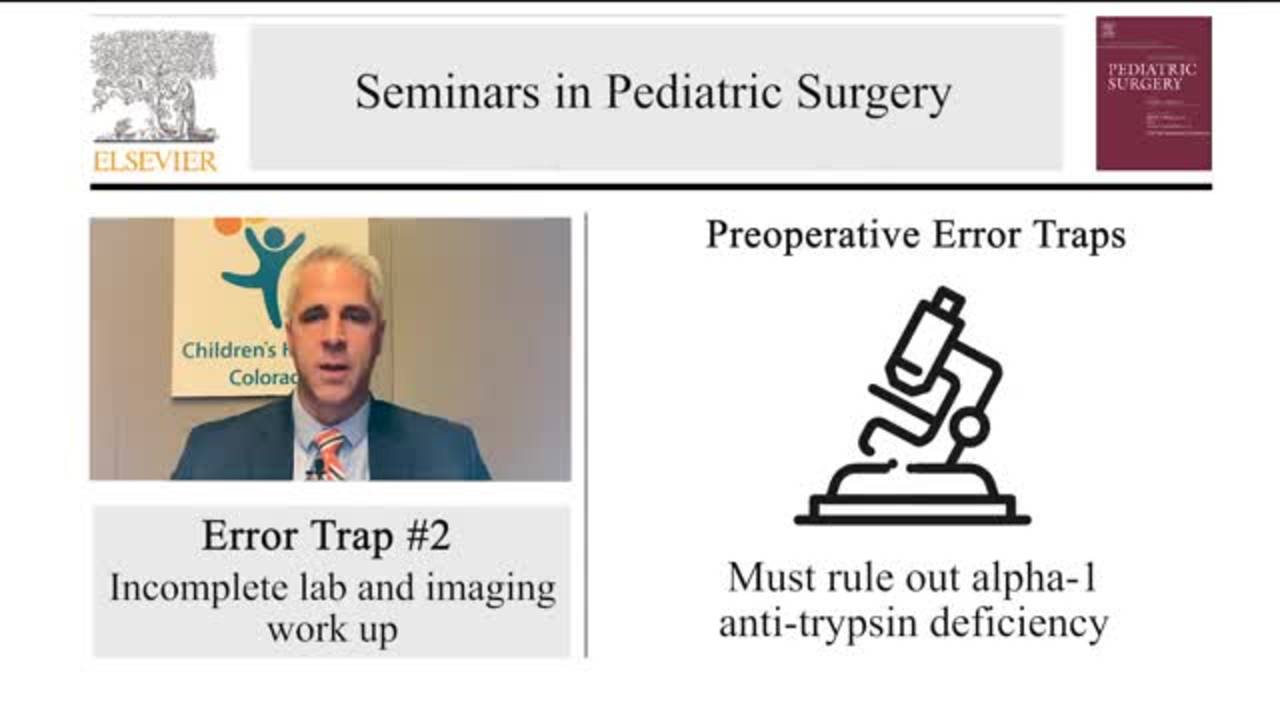
Error Traps and Culture of Safety in Biliary Atresia
CCHMC Pediatric Surgery · 4 min · Published Nov 2019
Podcast
Journal of Pediatric Surgery Article Review: 2nd Quarter (Apr-Jun) 2024
17 min · Published Sep 2024
Video
Update Course Rewind: MMP-7 & Biliary Atresia Diagnosis 2024
CCHMC Pediatric Surgery · 6 min · Published Mar 2025
Only a few other public items share this expert — go deeper there →
Video
Pediatric Surgical Oncology Research Collaborative (PSORC): Studying Rare Pediatric Tumors
56 s · Published May 2026
Video
Update Course Rewind 2025: Hirschsprung + ARM: Rare but Real
1 min · Published May 2026
Video
Update Course Rewind 2025: Hirschsprung + ARM: Rare but Real
1 min · Published May 2026
Video
Pooling Patients to Study Rare Pediatric Tumors: An Introduction to PSORC
56 s · Published May 2026
Video
The fetal frontier: A review of current and emerging fetal therapies for genetic diseases
44 s · Published May 2026
Video
Indocyanine green assists with sentinel lymph node mapping in pediatric and adolescent patients
1 min · Published May 2026
What the experts said
Dr. von Almen personally used steroids after Kasai in the past but has stopped based on the START trial results.
Two proposed mechanisms for steroid benefit in biliary atresia: reducing ongoing inflammation to preserve ductules, and acting as a choleretic to maintain bile flow (analogous to diuresis after kidney transplant).
The START trial specifically tested a 13-week course of high-dose steroids; the lack of benefit applies to that regimen.
Dr. Holcomb's institution switched to chlorhexidine with isopropyl alcohol (chloraprep) except for mucous membrane preps (e.g., circumcision).
Most pediatric surgery cases are clean (not clean-contaminated), so the Washington State study does not directly address pediatric practice.
Chloraprep or similar agents dry faster than betadine/iodine preps, allowing cases to start sooner; this matters when doing 6–7 cases per day.
Dr. Holcomb has not treated acute appendicitis non-operatively at his institution but knows of poor operative candidates treated successfully with antibiotics.
Immunosuppressed cancer patients with typhlitis (not appendicitis but similar) are sometimes treated non-operatively, and most resolve with antibiotics.
The challenge will be identifying which population of appendicitis patients can be treated successfully non-operatively versus which should undergo early operation.
Long-term follow-up is critical; even a 10-year follow-up leaves patients only 15–20 years old, with 40–50 years of life remaining at risk for recurrent appendicitis.
If appendectomy can be done as an outpatient same-day procedure, it may be difficult to argue for 1–2 days of antibiotics with uncertain long-term recurrence risk.
The protective effect of necrotizing enterocolitis on enteral autonomy is surprising and goes against understanding of that inflammatory illness, showing how much remains to be learned.
The PIFCON study underscores the importance of managing children with intestinal failure in multidisciplinary intestinal rehab programs, where catheter-associated bloodstream infection elimination and cholestasis prevention have changed outcomes.
Dr. Lipskar has not yet delayed an inguinal hernia repair for anesthetic concerns.
At Cohen Children's Medical Center, circumcisions outside the neonatal period are done with general plus regional anesthesia.
Regional anesthesia and agents like precedex may help decrease the amount of potentially neurotoxic general anesthesia; almost every laparoscopic, thoracoscopic, or open operation has a regional block option.
Dr. Ponsky's chief of anesthesiology instituted a 'rule of two': defer elective operations until after age 2 and avoid two anesthetics in one year.
Dr. Ponsky now defers dermoid cyst excision in a 6-month-old until 18 months but does not delay inguinal hernia repair due to known incarceration risk in young infants.
A survey of ~150 parents in a primary care pediatrics office found the vast majority did not know anesthetic neurotoxicity was a major issue (Dr. Lipskar's unpublished study, to be presented at AAP).
The START trial randomized 140 infants with biliary atresia to high-dose steroids (IV for 2 weeks, oral for 2 weeks, taper over 9 weeks) versus placebo within 72 hours of Kasai portoenterostomy.
The primary outcome was serum total bilirubin <1.5 mg/dL with native liver at 6 months post-Kasai; the study was powered to detect a 25% absolute treatment difference.
High-dose steroid therapy after Kasai did not result in a statistically significant treatment difference in bile drainage at 6 months: 58.6% in the steroid group versus 48.6% in placebo.
Survival without liver transplant at 24 months was not statistically different: 58.7% for steroids versus 49.4% for placebo.
Adverse events were common in both groups (near 80%), largely reflecting severe underlying liver dysfunction; steroid treatment was associated with earlier onset of serious adverse events.
The authors of the START trial believe anything less than a 25% difference in bile drainage is not worth the potential early complications of steroids.
A Washington State registry study of clean-contaminated adult general surgery cases (60% colorectal, 34% bariatric) found no single skin antiseptic agent associated with lower SSI risk than any other.
Isopropyl alcohol as part of the antiseptic mixture conferred no benefit: unadjusted SSI rate 4.5% without alcohol versus 4.6% with alcohol.
The registry could not identify SSI diagnosed after discharge, likely underestimating the true SSI rate; a recent report showed 50% or more SSIs are diagnosed after discharge.
Most SSIs occur 3–10 days after operation; average length of stay in the study was 6–7 days.
A pilot randomized trial in children aged 5–15 with non-perforated appendicitis (based on imaging) compared non-operative antibiotic treatment versus laparoscopic appendectomy; follow-up was one year.
Of 225 children with appendicitis, 50 were randomized (26 to surgery, 24 to antibiotics); 77 families declined participation.
In the antibiotic group, 2 of 24 underwent appendectomy during primary treatment, 1 had recurrent appendicitis at 9 months, and 6 more had appendectomy for recurrent pain or parental desire (none with histologic appendicitis)—total 9 of 24 (38% failure rate).
Median time to discharge was significantly shorter in the surgical group, but the antibiotic group had a stipulated 48-hour minimum hospitalization.
Cost for the initial inpatient stay was significantly lower in the antibiotic group despite longer hospitalization, highlighting the cost of undergoing an operation.
The pilot study demonstrates that a definitive randomized trial comparing antibiotics and laparoscopic appendectomy for non-perforated appendicitis is safe and feasible; a multi-center study is planned.
Some parents in the pilot study wanted their child's appendix removed to avoid future worry, even after successful antibiotic treatment.
A PIFCON multi-center cohort study of 272 children with intestinal failure (median follow-up 33 months) found enteral autonomy was achieved in 43%, 13% remained PN-dependent, and 43% died or underwent transplant.
Necrotizing enterocolitis as the underlying diagnosis, care at an intestinal rehab facility without a transplant center, and presence of an ileocecal valve were all statistically significantly associated with higher rates of enteral autonomy.
Residual small bowel length was also a statistically significant predictor of enteral autonomy, though less impressive than the other three variables.
A companion paper in the same journal (Journal of Pediatrics, July 2015) found necrotizing enterocolitis was a poor predictor of growth outcome in infants with short bowel syndrome.
Animal studies show that commonly used anesthetics and sedatives (propofol, etomidate, sevoflurane, isoflurane, ketamine) that increase GABA receptor activity or block glutamate receptors produce neurotoxic effects in laboratory animals from nematodes to nonhuman primates.
Observational studies in children undergoing early anesthesia offer conflicting results and are confounded by multiple factors, but suggest some children may have deficits—association, not causation.
SmartTots June 2014 statement concluded that animal data is sufficiently convincing to warrant large-scale clinical studies and recommended avoiding anesthesia in children under 3 unless urgent or potentially harmful if not attended to.