
Pectus Excavatum Pathway
With Dr. Rebecca L. Brown · StayCurrentMD
Part of
Pectus Excavatum 58 items
Cued at 2:03 · stops at 2:48 · press play
Educational content from recorded physician discussions — not medical advice. Talk to your (or your child's) care team about your situation.
Video
Update Course Rewind: Cryoanalgesia in Pectus Cases 2024
7 min · Published Apr 2025
Video
APSA - Is same day discharge possible following the Nuss repair for pectus excavatum - R. Luke Rettig
7 min · Published May 2022
Video
Criteria for Pectus Repair: Update Course 2015
55 s · Published Nov 2015
Video
Vacuum Bell Therapy for Pectus Excavatum: Long-term Experience at a Single Center
58 s · Published Apr 2025
Video
Novel index to estimate the cephalocaudal extent of the excavation in pectus excavatum - JPS article
1 min · Published May 2023
Video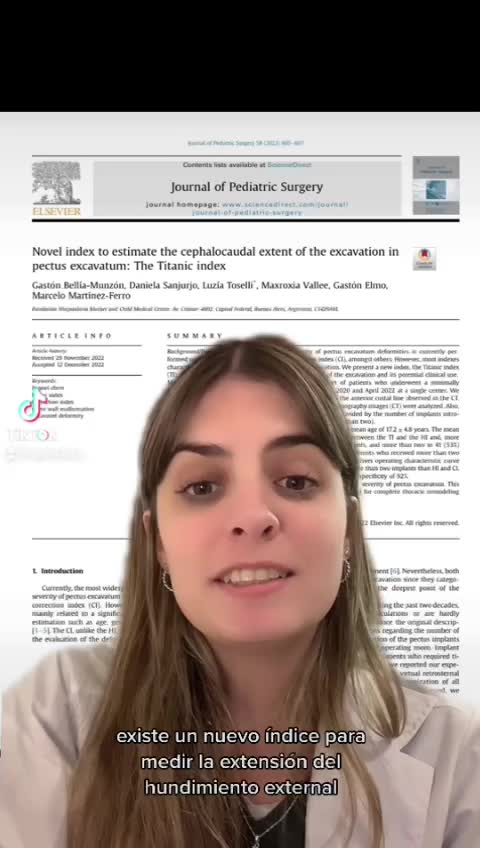
Novedoso indice para estimar la extensión cefalocaudal del hundimiento esternal en el pectus excavatum: El Índice Titanic
Published May 2023
Only a few other public items share this expert — go deeper there →
Video
Pediatric Surgical Oncology Research Collaborative (PSORC): Studying Rare Pediatric Tumors
56 s · Published May 2026
Video
Update Course Rewind 2025: Hirschsprung + ARM: Rare but Real
1 min · Published May 2026
Video
Update Course Rewind 2025: Hirschsprung + ARM: Rare but Real
1 min · Published May 2026
Video
Pooling Patients to Study Rare Pediatric Tumors: An Introduction to PSORC
56 s · Published May 2026
Video
The fetal frontier: A review of current and emerging fetal therapies for genetic diseases
44 s · Published May 2026
Video
Indocyanine green assists with sentinel lymph node mapping in pediatric and adolescent patients
1 min · Published May 2026
What the experts said
The pectus excavatum clinical care pathway has five major components: pain management, mobility, lung recruitment, daily intake, and daily output.
Preoperatively, compression boots are applied for pectus excavatum repair.
A type and screen is performed preoperatively for pectus excavatum repair.
Ancef is given prior to incision, or vancomycin if the patient is MRSA positive.
Preoperative washes of Dynahex or Hibiclens scrub are applied to prevent infection after pectus excavatum surgery.
Patients are placed on continuous pulse oximetry postoperatively.
Patients are given clear liquids and advanced as tolerated to a full regular diet on postoperative day 0.
Patients are encouraged to be out of bed to the chair and then to ambulate on postoperative day 0, especially if they are the first case of the day.
Incentive spirometry is performed 10 times per hour postoperatively.
Patients receive Ancef times 3 doses postoperatively, or clindamycin if they are MRSA positive.
An epidural is routinely used for pain management after pectus excavatum repair, supplemented with Valium, Robaxin, Toradol, IV Tylenol, methadone times 1, and scheduled Zofran for nausea.
Patients are encouraged to chew gum 5 separate times a day for 20 minutes if fully awake postoperatively.
For bowel management, patients are given Senna and MiraLax twice a day as well as Movantik.
The Foley catheter inserted during surgery is continued on postoperative day 1.
On postoperative day 1, patients are encouraged to be out of bed, up to a chair, and ambulating about the room 3 times a day.
The Foley catheter is removed on postoperative day 1 to encourage ambulation.
On postoperative day 1, the epidural remains in place and medications are supplemented with Valium, Robaxin, Toradol, IV Tylenol, and oxycodone is started orally once patients are tolerating a diet.
Maintenance IV fluids are continued until the patient is drinking well and urinates after Foley removal.
Zofran, initially given routinely every 8 hours, is changed to as needed on postoperative day 1.
On postoperative day 2, IV fluids are discontinued if still running.
The epidural catheter is stopped at 6 in the morning on postoperative day 2.
The epidural is removed when the pain team rounds later in the morning on postoperative day 2.
On postoperative day 2, the patient is transitioned to all oral pain medications including oxycodone, Valium, Robaxin, Motrin, and Tylenol.
A two-view chest X-ray is obtained on postoperative day 2 to evaluate bar location and to rule out any pleural effusion or pneumothorax.
Dressings are removed and the chest is washed daily starting on postoperative day 2.
On postoperative day 2, patients are encouraged to ambulate at least 3 times in the halls.
On postoperative day 3, physical therapy and occupational therapy work with the patient to help them walk up and down the stairs, and PT/OT will sign off once they are able to do this.
Prescriptions are filled and the medication schedule is given to the parent and patients on postoperative day 3.
The patient should be on oral pain medication only by postoperative day 3.
The patient is discharged home on postoperative day 3 if pain is well controlled and the patient is tolerating oral intake.
Since institution of the clinical care pathway about 2 to 3 years ago, length of stay has been reduced from 4.5 days to 3 days.
Since institution of the clinical care pathway about 2 to 3 years ago, patient satisfaction has increased.