
Error Traps and Culture of Safety in Anorectal Malformations
With Dr. Andrea Bischoff · StayCurrentMD
Cued at 0:34 · stops at 1:19 · press play
Educational content from recorded physician discussions — not medical advice. Talk to your (or your child's) care team about your situation.
More about anorectal malformations
same diagnosisVideo
Imperforate Anus Rapid Fire: Update Course 2015
CCHMC Pediatric Surgery · 6 min · Published Nov 2015
Podcast
Colorectal Quiz Episode 12: Newborn ARM Part 1
12 min · Published Jun 2021
Video
Transition From Pediatric to Adult Healthcare for Colorectal Conditions: A Systematic Review
58 s · Published Sep 2024
Video
Finnish Pediatric Surgery Hub - From Centralization to Collective Learning and Sharing of Expertise
48 s · Published Feb 2025
Video
Bowel Management for Hirschsprung's Disease Patients: Pediatric Bowel...
Dr. Todd Ponsky · 34 min · Published May 2013
Video
Post Operative Anal Dilatations for the Prevention of Anal Strictures in Children With Anorectal Malformation: A Systematic Review
48 s · Published Sep 2025
Video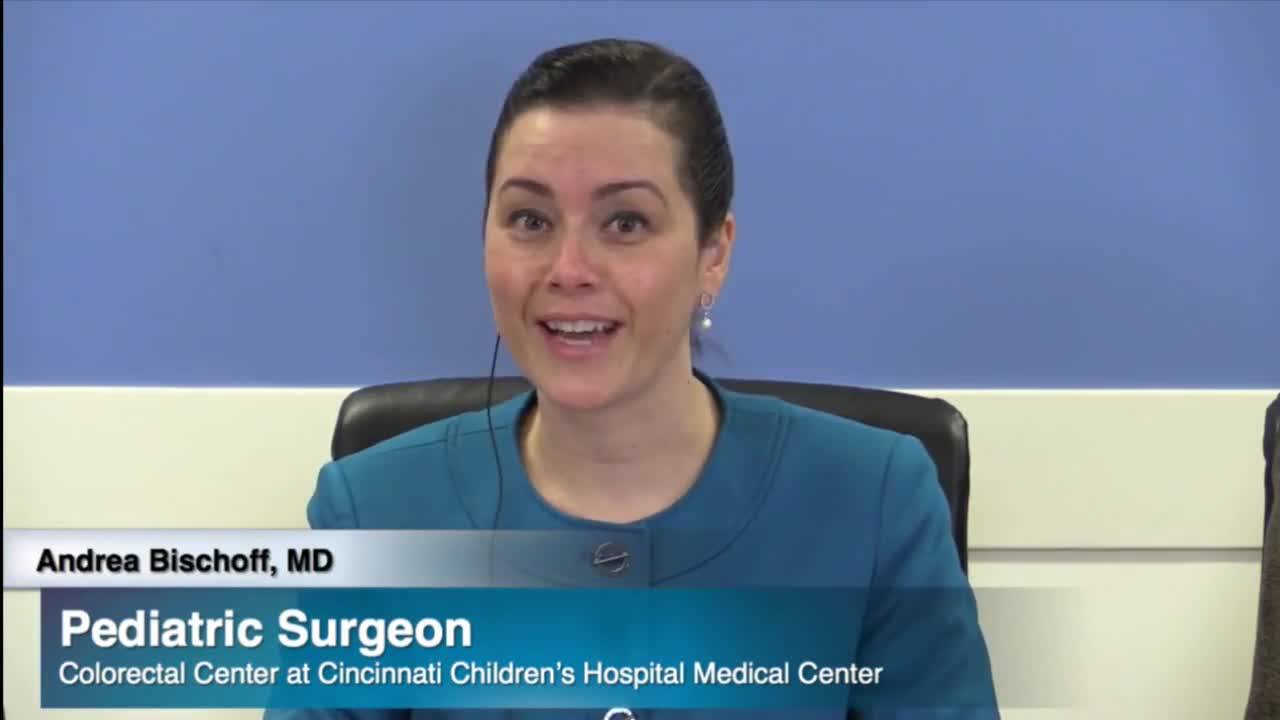
History of Hirschsprung Disease
CCHMC Pediatric Surgery · 18 min · Published Nov 2018
Video
Cloaca - Prental Imaging & Diagnosis - Counseling
Dr. Todd Ponsky · 36 min · Published Nov 2018
Podcast
Anorectal Malformations with Dr. Andrea Bischoff
47 min · Published Apr 2017
Podcast
Anorectal Malformations with Dr. Andrea Bischoff
47 min · Published Apr 2017
Video
Pediatric Surgical Oncology Research Collaborative (PSORC): Studying Rare Pediatric Tumors
56 s · Published May 2026
Video
Update Course Rewind 2025: Hirschsprung + ARM: Rare but Real
1 min · Published May 2026
Video
Update Course Rewind 2025: Hirschsprung + ARM: Rare but Real
1 min · Published May 2026
Video
Pooling Patients to Study Rare Pediatric Tumors: An Introduction to PSORC
56 s · Published May 2026
Video
The fetal frontier: A review of current and emerging fetal therapies for genetic diseases
44 s · Published May 2026
Video
Indocyanine green assists with sentinel lymph node mapping in pediatric and adolescent patients
1 min · Published May 2026
What the experts said
Five error traps have been identified in the management of anorectal malformations.
The first error trap is the creation of a colostomy too distal in the sigmoid colon.
The recommendation is for a colostomy at the descending colon.
The second error trap is having an inaccurate distal colostogram.
A correctly done distal colostogram should show the site of the mucous fistula, the amount of bowel length available for the pull-through, the end of the rectum or the connection to the urinary tract, whenever possible the bladder and the urethra, the tip of the sacrum, and the anal marker.
The third error trap is operating on a male patient without a Foley catheter and ignoring the hazards of the separation between the anterior rectal wall and the genitourinary tract.
The fourth error trap is attempting to dilate a true rectal stricture.
Anal dilations are not for real strictures.
The fifth error trap is not offering long-term follow-up to these patients.
Patients with anorectal malformations need long-term follow-up in colorectal, urology, and gynecology.
By avoiding these common error traps, patients will receive better care.