
Colorectal Quiz: Episode 43
With Dr. Jeffrey Avanzino & Dr. Mark Levitt & Dr. Jason Frischer & Dr. Hira Ahmad · hosted by Dr. Philippa Jalus · Marc Levitt
Cued at 19:03 · stops at 19:48 · press play
Educational content from recorded physician discussions — not medical advice. Talk to your (or your child's) care team about your situation.
More about anus without fistula
same diagnosisOnly a few other public items share this diagnosis — nothing to add yet.
Podcast
(500) Days of Summer (classic Movie Review: Zooey Deschanel, Joseph Gordon-Levitt, Marc Webb) by The Cory Baker Show
Marc Levitt · Published Aug 2026
Video
Meeting with Marc Levitt: Clinical Discussion with Ivon Martinez
Marc Levitt · Published Jul 2026
Video
Introducing Dr. Marc Levitt: Pediatric Colorectal Surgeon Profile
Marc Levitt · Published Jul 2026
Video
Integrated Care Concept in Pediatric Colorectal Surgery by Marc Levitt
Marc Levitt · Published Jul 2026
Video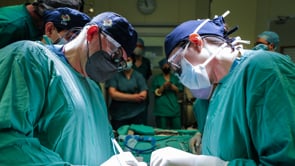
Patient Outreach and Communication in Pediatric Colorectal Surgery
Marc Levitt · Published Jul 2026
Video
Keynote Address on Pediatric Colorectal Surgery by Dr. Marc Levitt
Marc Levitt · Published Jul 2026
Only a few other public items share this expert — go deeper there →
Video
Dr. Marc Levitt on the CTO Mission in Pediatric Colorectal Surgery
Marc Levitt · Published Jul 2026
Video
Addressing Ministers of Health: Pediatric Colorectal Surgery Advocacy and Global Healthcare Priorities
Marc Levitt · Published Jul 2026
Video
Andrea Kesar Discusses Marc Levitt's Contributions to Pediatric Colorectal Surgery
Marc Levitt · Published Jul 2026
Video
Introduction to Dr. Marc Levitt's Pediatric Colorectal Surgery Practice
Marc Levitt · Published Jul 2026
Video
The History of International Colorectal Surgery Team Development
Marc Levitt · Published Jul 2026
Podcast
Hirschsprung's Disease with Dr. Marc Levitt
Marc Levitt · 22 min · Published Jul 2026
What the experts said
About 60% of the time there is success with using a split appendix for both Malone and Mitrofanoff, but about 40% of the time you cannot make it work.
For leaking Malones, first ensure patient is cleaning themselves out with effective enemas and consider thickening stool with water-soluble fiber before attempting surgical plication.
The longer the appendix, the less likely it will leak based on Poiseuille's law (flow through a tube based on radius to fourth power and length).
Dr. Frischer and Levitt did 10 Malones in a row without plicating and five leaked, so they decided to plicate them all and have not had a leakage in several years.
If appendix is short and stumpy, it is best for the Malone and the Mitrofanoff should be made from small bowel.
If appendix is 5 to 7 centimeters, that is not enough to share and should go for the Mitrofanoff because long term the Mitrofanovs do much better, requiring a neo-Malone.
If appendix is 7 centimeters or greater it can be split, requiring minimum 2 centimeters for the Malone and 5 centimeters minimum for the Mitrofanoff.
Small bowel volvulus around the appendix can occur but is rare, seen in only two or three cases.
When doing a neo-Malone, try to orient the channel so the catheter enters into the right colon rather than refluxing into the ileum.
If patient with Malone is not doing well and flushes are not working or they are getting significant symptoms like nausea, you must do a contrast study through the Malone to check for reflux into the terminal ileum.
When doing plication, pass the tube after each stitch to ensure it passes in the desired direction.
Using a 10 French coude catheter as a bougie during plication and checking passage afterward usually prevents single offending stitches from causing obstruction.
Using a 10 French tube (not 8), leaving it in for a month, and cathing twice a day can minimize stenosis rate.
Leaving indwelling tubes in Malones increases the amount of prolapse, likely due to pressure on the appendiceal base pushing up mucosa.
Urologists almost never get stenosis of Mitrofanovs because they catheterize every four hours; applying this to Malones by cathing twice daily has reduced stenosis rate.
For patients who cannot catheterize their Malone after surgery, a Malone plug can be used for a few months with gradual tapering of the time the tract is allowed without the plug.
Lone Star ring and pins can be placed in the umbilicus to get excellent exposure to visualize a tiny Malone hole.
For lost Malone access, blow up a balloon on a Foley catheter to occlude the umbilicus and inject dye under pressure to find any micro hole tract.
Ultrasound can be used to find the appendix around the umbilicus and needle localize the lumen for access rescue.
Appendicitis in a Malone is impossible unless the hole closes, because there is no obstruction in pathophysiology.
Do not take out the appendix in a first Crohn's or ARM patient or a kid with spine issues or absent sacrum or spina bifida, as they may need it for future Malone or Mitrofanoff.
In South Africa, appendix is never removed as part of laparoscopic appendectomy for appendicitis; it is a United States practice.
Appendix tips should be sent to pathology because neuroendocrine tumors (carcinoids) can be found; one was discovered three months after pathology insisted on receiving specimens.
The most common complication of Malone procedure is stricture occurring in 17 to 20% of patients.
In the late 2000s, urologists used deflux procedure (biodegradable gel injection) for Malone leakage, extrapolated from ureter reflux management.
Dr. Frischer's research has shown that a neo-Malone does just as well as a Malone.
An appendix-based Mitrofanoff does much better than a small bowel Monty.
Visualizing a floppy cecum with laparoscope means checking alignment of Treitz ligament before completing the case, as patient could have malrotation and volvulus risk.
Only 10 to 20% of patients will have problems with their Malone post-procedure.
If interventional radiology cannot replace a catheter into a Malone, the patient may need to return to surgery to identify where the tract is kinked.