
Journal of Pediatric Surgery Article Review: 2nd Quarter (Apr-Jun) 2025
With Dr. George W. Holcomb III & Dr. Eric Skarsgard & Dr. Preet Bir & Dr. Sean Kunisaki · hosted by Dr. Em Gootee · StayCurrentMD
Cued at 2:44 · stops at 3:29 · press play
Educational content from recorded physician discussions — not medical advice. Talk to your (or your child's) care team about your situation.
Podcast
Journal of Pediatric Surgery Article Review: 1st Quarter (Jan-Mar) 2025
16 min · Published May 2025
Video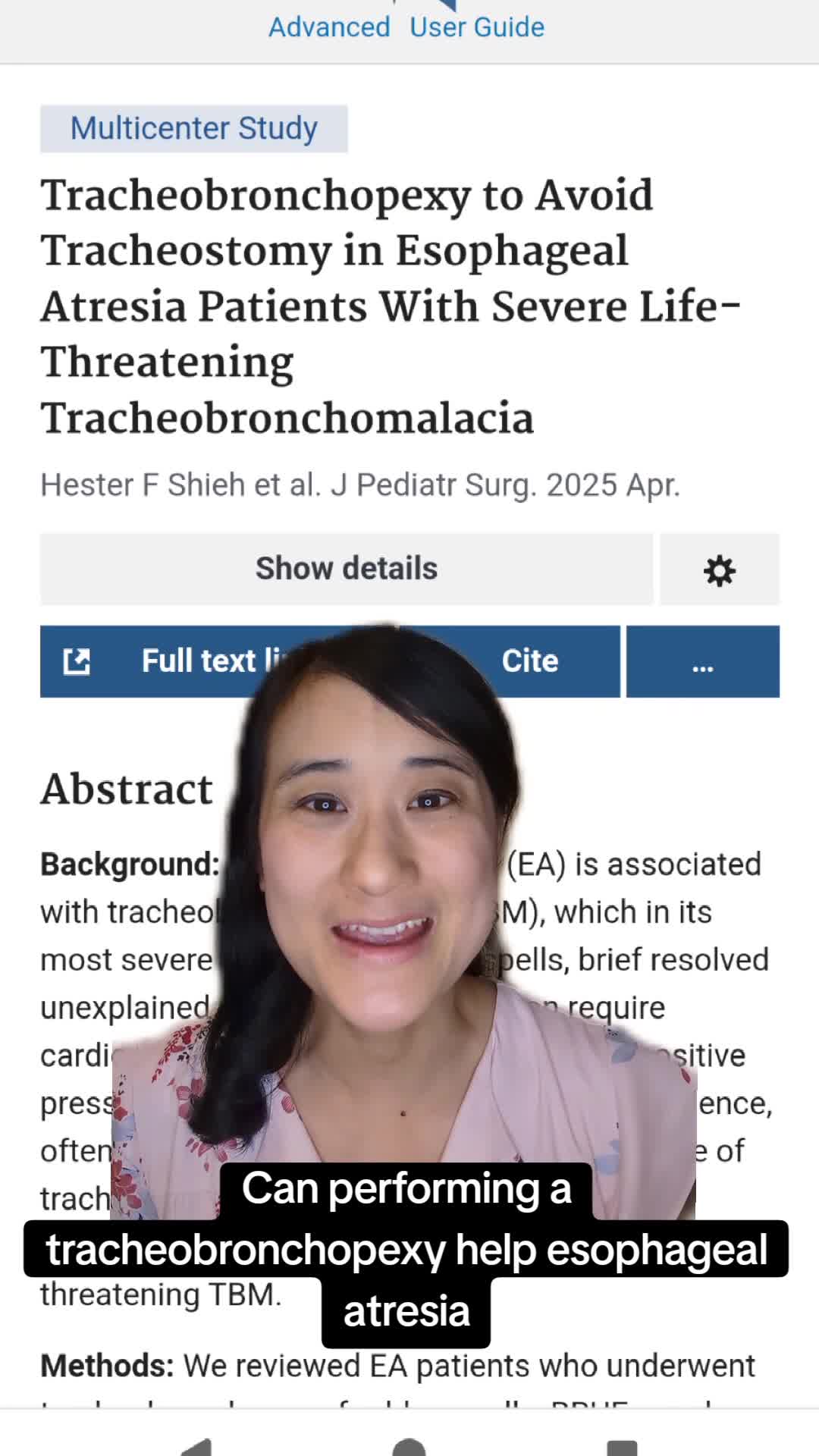
Tracheobronchopexy to Avoid Tracheostomy in Esophageal Atresia Patients With Severe Life-Threatening Tracheobronchomalacia
50 s · Published Apr 2025
Video
Finnish Pediatric Surgery Hub - From Centralization to Collective Learning and Sharing of Expertise
48 s · Published Feb 2025
Video
Esophageal Surveillance Practices in Esophageal Atresia Patients
Published Jul 2023
Podcast
Case Based Journal Review: Esophageal Atresia in 2022
17 min · Published Aug 2022
Video
QUAD Conference Commercial
1 min · Published May 2022
Only a few other public items share this expert — go deeper there →
Video
Pediatric Surgical Oncology Research Collaborative (PSORC): Studying Rare Pediatric Tumors
56 s · Published May 2026
Video
Update Course Rewind 2025: Hirschsprung + ARM: Rare but Real
1 min · Published May 2026
Video
Update Course Rewind 2025: Hirschsprung + ARM: Rare but Real
1 min · Published May 2026
Video
Pooling Patients to Study Rare Pediatric Tumors: An Introduction to PSORC
56 s · Published May 2026
Video
The fetal frontier: A review of current and emerging fetal therapies for genetic diseases
44 s · Published May 2026
Video
Indocyanine green assists with sentinel lymph node mapping in pediatric and adolescent patients
1 min · Published May 2026
What the experts said
The tracheobronchopexy series included 80 patients, which is a huge number - most pediatric surgeons won't see 10 of these patients in their career, and many wouldn't see 5
In experienced hands who have done numerous or hundreds of these type procedures, tracheobronchopexy can have very good outcomes for patients with severe airway collapse symptoms
Canada is the 2nd largest country in the world geographically, though population-wise smaller than California
The majority of Canada's population lives within 200 kilometers of the US border, but there are definitely lots of children in remote communities where it is not easy to access care
Outreach services were present in only 7 out of 10 provinces, and only 8 out of 18 children's hospitals (44%) provided outreach services
In most places in Canada, no one would ever transfer a 16 or 17 year old with appendicitis to a children's hospital for surgery - physiologically and every other way they're an adult and clearly do not need the expertise of a pediatric surgeon
Access to surgical care for children in Canada has been in need of improvement for decades
It's a misconception that the Canadian healthcare system ensures timely care - it actually doesn't, and children wait for surgery beyond their wait time target
Newfoundland and Labrador has the best outreach setup with only two pediatric surgeons who have established outreach clinics all over the province, serving as a model for others
The population of Newfoundland and Labrador is really rural and spread out, and geographically and weather-wise it can be impossible sometimes to access care or financially devastating
There are measurable costs in terms of time required to be seen and actual clinical outcomes for patients living remote from accessible high quality care
In the NSQIP database, 5% of all pediatric procedures were G-tube, which is a pretty sizable percent
77% of G-tube cases were first-time G-tubes as opposed to redos
The heterogeneity in use of preoperative upper GIs was extremely broad with no real reason for it, indicating a potential teaching moment
An additional 5.5% of G-tubes were dislodged in the 31 to 60 day period
Dislodgement rates are higher than rates of readmissions or IR interventions, making them a great QI target
If you can get dislodgements down, ED visits go down - when dislodgements happen early, patients are told to come back to the ED
A subset of children after esophageal atresia repair experience severe airway collapse, leaving them ventilator dependent or suffering repeated cyanotic spells
90% of patients on dynamic bronchoscopy showed complete airway collapse
Three-quarters of tracheobronchopexy procedures used a posterior approach
Tracheobronchopexy was performed on thoracic trachea alone in over half the patients, but had to be extended onto the bronchi in 40%
94% of tracheobronchopexy patients avoided tracheostomy with a mortality rate of 5%
Tracheobronchopexy significantly reduced pressure ventilation and ventilator dependence
A significant number of outreach services are located within 50 kilometers of a children's hospital, leaving vast regions without access to pediatric surgical care
The study examined 4,612 G-tube placements from 71 NSQIP-Pediatric hospitals in 2023
Upper GI studies were obtained in 45% of first-time G-tube cases with substantial interhospital variability from 0 to 99%
14% of G-tube cases resulted in an ED visit within 0 to 30 days
5.2% of G-tube cases involved dislodgement within 0 to 30 days