
 StayCurrentMD
Surgical Site Infections
Everything in the library about surgical site infections — built automatically from the recorded discussions that name it
Educational content from recorded physician discussions — not medical advice. Always talk to your child's care team about your child's situation.
Content of this collection
Surgical Management
4 items


PAPS - Optimizing skin antisepsis for neonatal surgery - Sophie Carr
Watch →
Listen to Sophie Carr gave her presentation of "Optimizing skin antisepsis for neonatal surgery" at the first ever Best of the Best in Pediatric Surgery event.
video · May 2022
PAPS Best of the Best Winner
Watch →
The PAPS winner at the Best of the Best in Pediatric Surgery event on April 8th, 2022 was Sophie Carr with her presentation "Optimizing skin antisepsis for neonatal surgery".
video · May 2022
Update Course Rewind: Effects of Mechanical Bowel Prep on SSIs 2022
Watch →
We are back with another Update Course Rewind video! This time we are presenting you "Effects of Mechanical Bowel Prep on SSIs" with Dr. Paul Jeziorczak from APSA Professional Development Committee.
Host: Ellen Encisco
video · Jun 2023
Surgical Site Infections and Perioperative Antibiotic Use in Children with Medical Complexity
Watch →
This video discusses preventing surgical site infections (SSIs) in children with medical complexity, who face a significantly higher risk than other patients. Lizzy Lee from Cincinnati Children's explains that the solution isn't simply more
video0:52 · Aug 2026
Evidence & Research
6 items

Improve Wound Misclassification with Focused Education
Watch →
Authors Marilyn W. Butler, Sandy Zarosinski and Dagmar Rockstroh describe a standardized training program to improve surgical wound classification accuracy, including a list of all pediatric surgery procedures by wound class. https://www.jp
video · Mar 2019
MediByte - Intraoperative temperatures impact on postoperative infections
Watch →
Dr. Patrick Chung reviews the key points of Walker and colleagues study "Effects of Intraoperative Temperatures on Postoperative Infections in Infants and Neonates" from the Journal of Pediatric Surgery.Link to the full article: gcmd.co/Op
video · May 2020
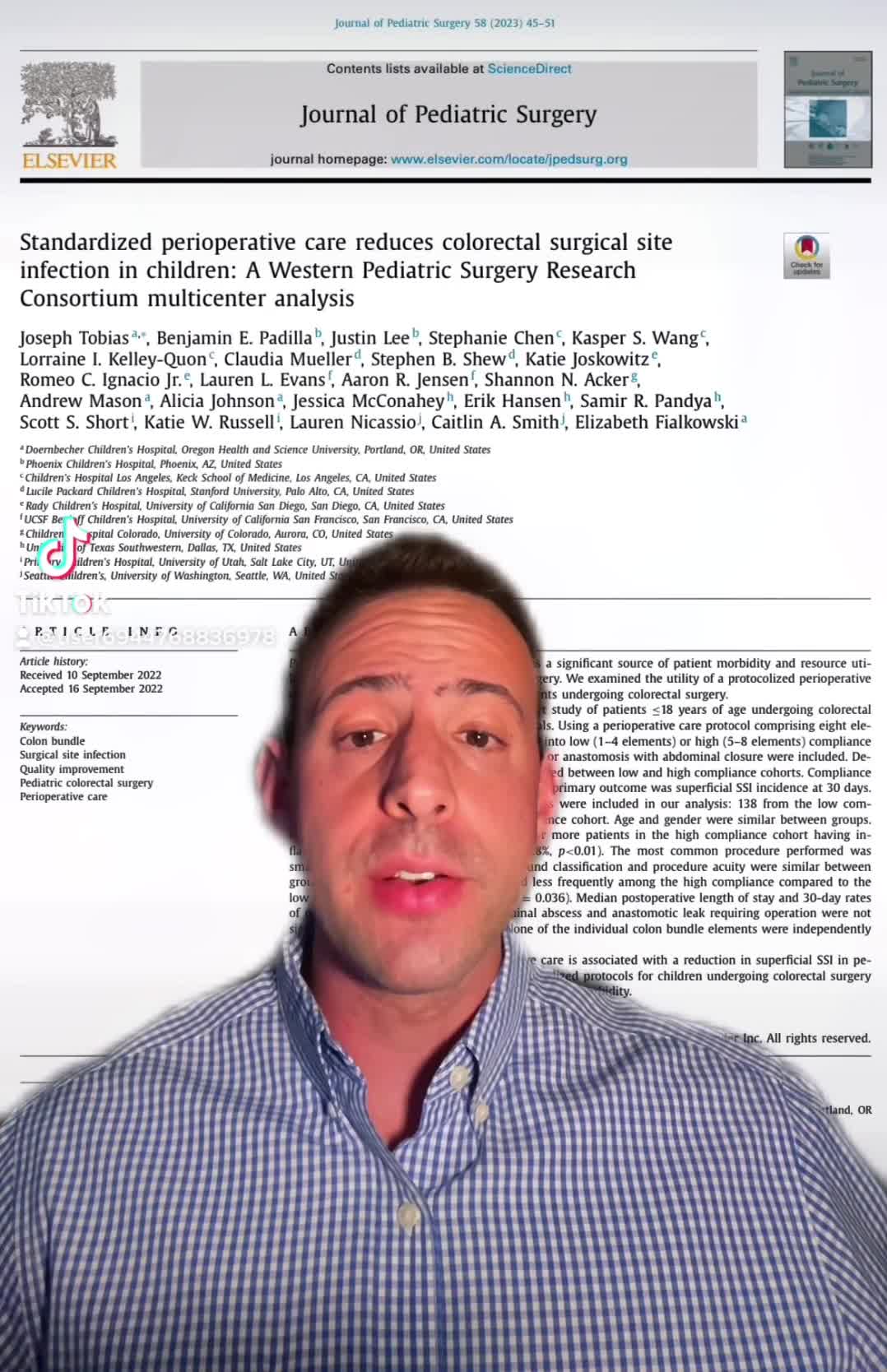
Standardized perioperative care reduces colorectal surgical site infection in children
Watch →
New article you should know! by Dr. Alex Halpern
"Standardized perioperative care reduces colorectal surgical site infection in children: A Western Pediatric Surgery Research Consortium multicenter analysis” Joseph Tobias et.al.
Full
video1:02 · Apr 2023
El cuidado perioperatorio estandarizado reduce las infecciones del sitio quirúrgico en niños
Watch →
Nuevo articulo que tenes que conocer por l Dr. Carlos Colunga
"El cuidado perioperatorio estandarizado reduce las infecciones del sitio quirúrgico en niños" Joseph Tobias et.al.
Articulo completo: https://www.jpedsurg.org/article/S0022-
video · Apr 2023
The Role of Diversion During Ileal Pouch Anal Anastomosis (IPAA) Creation in Pediatric Ulcerative Colitis - JPS
Watch →
New article you should know from Journal of Pediatric Surgery by Cecilia Gigena
"The Role of Diversion During Ileal Pouch Anal Anastomosis (IPAA) Creation in Pediatric Ulcerative Colitis"
Authors: Ursula Adams, Chris Agala, Topher Mc
video · Feb 2024
El papel de la ostomía durante la creación del Pouch ileal coon anastomosis anal (IPAA) en la colitis ulcerosa pediátrica - JPS
Watch →
Nuevo articulo que tenes que conocer de la revista JPS por la Dra. Cecilia Gigena
"El papel de la ostomía durante la creación del Pouch ileal coon anastomosis anal (IPAA) en la colitis ulcerosa pediátrica"
Autores: Ursula Adams, Chris
video · Feb 2024
Summaries and takeaways+ Show
The doctors in this collection+ Show
All expert statements+ Show
Every expert statement below comes from the recorded discussions, with its speaker and moment.
Surgical Site Infections and Perioperative Antibiotic Use in Children with Medical Complexity
Children with medical complexity face a much higher risk of surgical site infections than other patients.
host_summaryLizzie Lee0:07 ↗
The answer to preventing SSI in medically complex children is not simply giving them more antibiotics.
host_summaryLizzie Lee0:13 ↗
Standardized infection prevention practices include preoperative bathing, proper skin cleaning, screening certain patients for MRSA, and careful wound care.
host_summaryLizzie Lee0:17 ↗
The standard antibiotics used before surgery (like cefazolin) are usually enough, even for medically complex children.
host_summaryLizzie Lee0:26 ↗
One opportunity to improve care is making sure children who are not truly allergic to beta-lactam antibiotics can still receive the most effective medication.
host_summaryLizzie Lee0:35 ↗
Preventing surgical site infections takes a team of nurses, surgeons, and specialists.
host_summaryLizzie Lee0:44 ↗
Standardized perioperative care reduces colorectal surgical site infection in children
Surgical site infections are a major cause of perioperative morbidity in children undergoing colorectal surgery
epidemiologicalAlex Halpern0:00 ↗
The Western Pediatric Surgery Research Consortium conducted a prospective cohort study on children undergoing colorectal surgery across 10 hospitals in the US
clinicalAlex Halpern0:20 ↗
The study utilized an 8-part perioperative care bundle
clinicalAlex Halpern0:32 ↗
Children were split into either a high or low compliance group based on adherence to the care bundle
clinicalAlex Halpern0:32 ↗
Children in the high compliance group had a statistically significant decrease in rates of superficial surgical site infection when compared to children in the low compliance group
clinicalAlex Halpern0:41 ↗
Standardization of perioperative care may decrease morbidity and improve outcomes in colorectal surgery
opinionAlex Halpern0:41 ↗
PAPS Best of the Best Winner
Surgical site infections are a costly yet modifiable source of morbidity, particularly within the neonatal population.
clinicalSophie Carr1:55 ↗
A growing body of evidence in adults suggests that chlorhexidine gluconate and isopropyl alcohol provide superior protection against SSIs than povidone.
host_summarySophie Carr2:15 ↗
Equivalent data does not yet exist for the neonatal surgical population for CHG versus povidone antisepsis.
epidemiologicalSophie Carr2:28 ↗
CHG antisepsis is commonly used for invasive non-surgical procedures in NICUs and for prevention of newborn nosocomial infections in developing countries.
host_summarySophie Carr2:35 ↗
Current product labeling discourages CHG-IPA antisepsis in infants under two months of age due to limited safety data and concerns around adverse effects, particularly skin injuries.
host_summarySophie Carr2:48 ↗
The neonatal skin antisepsis protocol included lower limits of 34 weeks post-conception age and 1500 grams weight, limited to general surgery patients only.
clinicalSophie Carr3:30 ↗
The protocol used either 2% or 0.5% CHG based on age cutoffs.
clinicalSophie Carr3:45 ↗
Skin integrity was assessed using a validated tool called the neonatal skin condition score.
clinicalSophie Carr3:52 ↗
Implementation of the protocol occurred in February 2020.
clinicalSophie Carr4:15 ↗
A total of 50 patients were included in the protocol, none of which experienced adverse skin prep outcomes.
clinicalSophie Carr4:25 ↗
8% of patients on the CHG protocol developed SSIs within the 30-day post-op period compared to 14% in the matched retrospective povidone cohort.
epidemiologicalSophie Carr4:35 ↗
A comparison of SSI rates between the CHG versus povidone cohort revealed no significant difference.
epidemiologicalSophie Carr4:48 ↗
The majority of cases were class two clean-contaminated cases.
clinicalSophie Carr6:20 ↗
The protocol was largely modeled off the McGill protocol used in Quebec, Canada, which used a lower age cutoff of 28 weeks gestational age with a lower weight cutoff of 1,000 grams.
clinicalSophie Carr7:00 ↗
Less than 28 weeks gestational age is the primary population affected by adverse skin reactions in the literature.
host_summarySophie Carr7:45 ↗
The project was conducted in conjunction with multiple SSI reduction initiatives including optimizing antibiotic prophylaxis, using adherent draping, and implementing a clean closure bundle for class two clean-contaminated cases.
clinicalSophie Carr8:00 ↗
The clean closure bundle included changing gloves prior to closure.
clinicalSophie Carr8:25 ↗
The decrease in SSI rate from 14% to 8% was not statistically significant.
epidemiologicalSophie Carr9:43 ↗
What's new+ Show