
Pulmonary Hypertension
Everything in the library about pulmonary hypertension — built automatically from the recorded discussions that name it
Educational content from recorded physician discussions — not medical advice. Always talk to your child's care team about your child's situation.
Content of this collection
Acute Management
1 item
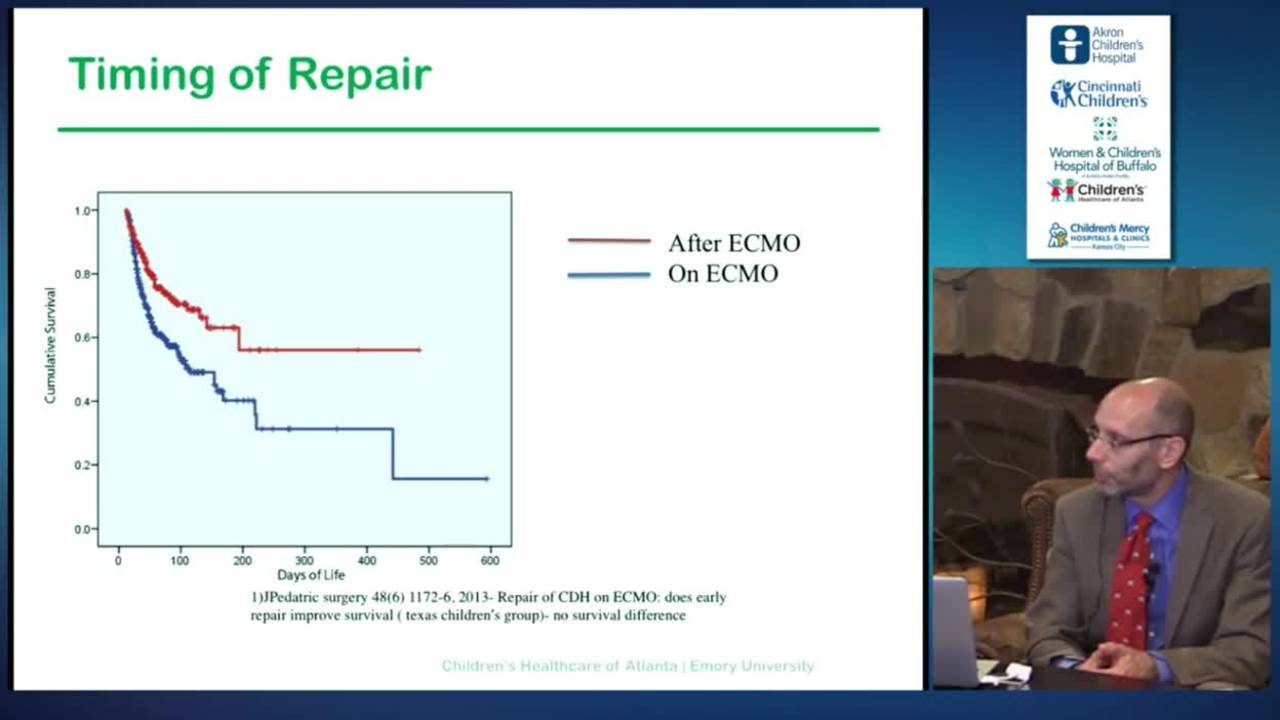
CDH-ECMO - VV vs. VA - Repair on ECMO: Update Course 2015
Watch →
Dr. Wulkan, Surgeon-in-Chief, Children's Healthcare of Atlanta, presents a case of a 35 week gestational aged female with respiratory distress at birth and the ECHO shows super-systemic pulmonary pressure. The case study generated debate am
video10:45 · Jan 2019
Surgical Management
2 items


Challenges in Diaphragmatic Hernia Repair: Update Course 2016
Watch →
Dr. Mark Wulkan discusses recurrent and complicated congenital diaphragmatic hernia repairs. Dr. Wulkan's presentation includes insight of indications of these hernias, contraindications to MIS repair, pericostal suture, SIS underlay mesh,
video44:15 · Oct 2018
CDH-ECMO Routine Patient Preoperative Workup, Timing, Technique: Update...
Watch →
Dr. Wulkan, Surgeon-in-Chief, Children's Healthcare of Atlanta,presents a routine newborn with congenital diaphragmatic hernia diseaseand discusses and debates preoperative workup, timing, and technique. Dr. Wulkan suggests ECHOto be a key
video3:31 · Jan 2019
Complications
1 item

Update Course Rewind: Omphalocele & Gastroschisis 2020
Listen →
Abdominal wall defects like omphalocele and gastroschisis can present in interesting ways. At last year
podcast15:18 · Jun 2026
Summaries and takeaways+ Show
The doctors in this collection+ Show
All expert statements+ Show
Every expert statement below comes from the recorded discussions, with its speaker and moment.
Update Course Rewind: Omphalocele & Gastroschisis 2020
Giant omphalocele is typically defined as five centimeters or greater or liver in the sac
clinical0:36 ↗
In a two-center retrospective study encompassing 20 years with 97 survivors of giant omphalocele, patients had greater time to full feeds, required more TPN, had more chromosomal anomalies, and had higher incidence of respiratory insufficiency
epidemiological0:36 ↗
56 patients of 97 giant omphalocele survivors were identified as having pulmonary hypertension, most diagnosed within the first week of life
epidemiological1:14 ↗
Five patients out of 56 with pulmonary hypertension had no signs in their first echo within the first seven days of life, then subsequently developed severe pulmonary hypertension after an episode of sepsis; two died and one required pulmonary vasodilator for more than a year
clinical1:14 ↗
Even in omphalocele patients without signs of respiratory compromise early, sepsis later puts these patients at high risk for pulmonary hypertension
clinical1:14 ↗
Dr. Miguel Guelfand uses hydrocolloid dressing to make a silo for giant omphalocele without painting the sac, achieving closure in 97% within 30 days and 92% within 15 days in 40 patients
clinical3:46 ↗
For hydrocolloid dressing technique, the dressing should be placed within the first 24 hours so the sac doesn't get very stiff, and the hydrocolloid makes the sac very smooth and hydrated
clinical4:26 ↗
Dr. Guelfand's team keeps all giant omphalocele patients in ICU ventilated and completely paralyzed during active reduction
clinical4:20 ↗
For ruptured omphalocele, Dr. Guelfand's team sutures the omphalocele and then applies the hydrocolloid dressing; they have treated three such patients
clinical4:45 ↗
The risk of midgut volvulus was higher in patients with omphalocele compared to gastroschisis, and there was increased risk of adhesive bowel obstruction with gastroschisis
epidemiological5:17 ↗
If exposing the intestines in omphalocele patients, it is worthwhile doing a Ladd procedure at the time because these patients have non-rotation or mal-rotation, and non-rotation does not exclude the possibility of having anatomy with a narrow base of mesentery
clinical5:17 ↗
Dr. Guelfand uses proline mesh for huge gastroschisis or omphalocele cases when there is no place for hydrocolloid, protecting it with a plastic bag within the bowel; this technique has been used for 15 years
clinical8:18 ↗
When a Bentec spring-loaded silo is placed for giant abdominal wall defect and pushed down, the forces go out and actually make the defect much bigger over time
clinical8:49 ↗
Dr. Islam's team used biologic mesh as a scaffold for a large abdominal wall defect, which sticks to the bowel and creates a scaffold to allow skin to epithelialize, then used circumcision skin as a graft, followed by plastic surgery tissue expanders and flaps for coverage
clinical9:14 ↗
Component separation technique involves separating tissue at the external oblique about a centimeter beyond the rectus sheath on both sides, dissecting between external and internal oblique, and optionally making an incision on the anterior rectus sheath for another centimeter of space
host_summaryEllen Encisco10:26 ↗
A Texas report described component separation use in nine children aged seven days to 10 years, mostly for omphaloceles and giant defects, achieving fascial closure in the vast majority with some mesh use for bridging
host_summaryEllen Encisco10:26 ↗
Complex gastroschisis is almost a different disease from simple variety; everything is worse including hospital length of stay, requirement for further operations, and sepsis rates
clinical12:25 ↗
In sutureless gastroschisis closure, the silo is placed or bowel is tucked in with occlusive dressing, changed at five days, and mostly closed by the next change, then simple dressings can be used
clinical12:25 ↗
Comparing sutured versus sutureless gastroschisis closure, there was no difference in time to full feeds, TPN use, or duration of hospital stay, but sutureless had fewer anesthetics, less frequent antibiotic use, and fewer infections and septic events
epidemiological12:25 ↗
A randomized trial of over 50 gastroschisis patients found no difference between immediate closure and silo placement
epidemiological12:25 ↗
The finding of no difference between silo and immediate closure paved the way for studying sutureless closure, because it established that immediate closure was not superior before moving to sutureless technique
opinion12:25 ↗
Challenges in Diaphragmatic Hernia Repair: Update Course 2016
Indication for minimally invasive CDH repair is any patient stable enough to transport to OR, with pulmonary pressures lower than systemic.
guideline0:00 ↗
Most centers wait to repair CDH until right-sided (pulmonary) pressures are lower than systemic pressures.
host_summary1:00 ↗
Contraindications to MIS CDH repair include repair on ECMO; liver-up, stomach-up, oscillator use, and redo repair are NOT contraindications.
guideline1:30 ↗
A laparotomy for CDH repair carries significant lifelong risk of small bowel obstruction, which may be underestimated and is a major advantage of MIS approach.
opinion3:00 ↗
Early studies from Babies Hospital showed relatively high recurrence rate for primary MIS CDH repair, but this may be related to technique.
host_summary2:30 ↗
Technical pearls for MIS CDH repair include pericostal sutures, mesh reinforcement, and avoiding tension; agenesis or near-agenesis should prompt conversion to open.
clinical3:30 ↗
All CDH patients have obligate pneumothorax post-repair due to pulmonary hypoplasia; chest tube use is debated.
clinical7:00 ↗
Biologic mesh alone to bridge a CDH defect is associated with higher recurrence rates; biologics dissolve in the middle due to lack of tissue ingrowth on the chest side.
clinical10:00 ↗
PTFE-biologic sandwich technique (PTFE on lung side, biologic on abdominal side) reduces recurrence compared to biologic alone, particularly for dome recurrences.
clinical10:40 ↗
What's new+ Show