
Collection
Neonatal Surgery Essentials
Educational content from recorded physician discussions — not medical advice. Always talk to your child's care team about your child's situation.
Content of this collection
Congenital Anomalies
2 items


Diaphragmatic Hernia1 item
Congenital Diaphragmatic Hernia with Dr. Charlie Stolar
Listen →
Dr Charlie Stolar discusses key points of CDH with Dr. Todd Ponsky. EDITED BY NICHOLAS BRUNS, MD and IAN GLENN, MD.In this episode, Dr. Charles Stolar from Columbia University College of Physicians and Surgeons and California Pediatric Sur
podcast1:22:05 · Dec 2020
Esophageal Atresia1 item
Type of pledget and suture technique relative to esophageal tensile strength in long-gap esophageal atresia
Read →
Purpose Methods Results Conclusion
article · May 2026
Neonatal Emergencies
2 items

Gastric Necrosis1 item
Neonatal Gastric Necrosis: Pediatric Surgery Difficult Cases-Innovative...
Watch →
During the Pediatric Surgery Tricks of the Trade and Difficult Cases: Innovative Solutions to Common Problems Course in 2013, Dr. Sherif Emil gives an informative case presentation of neonatal gastric necrosis.
video15:51 · Sep 2018
Intestinal Complications1 item
Mucous fistula refeeding in neonates: a systematic review and meta-analysis
Read →
New infographic by Dr. Jose Campos and the Chilean society of pediatric surgery
"Mucous fistula refeeding in neonates: a systematic review and meta-analysis"
Authors: Gonzalo Solís-García, Bonny Jasani
Full article: https://pubmed.
article · Jul 2023
Perioperative Care
3 items


Enhanced Recovery Protocols2 items
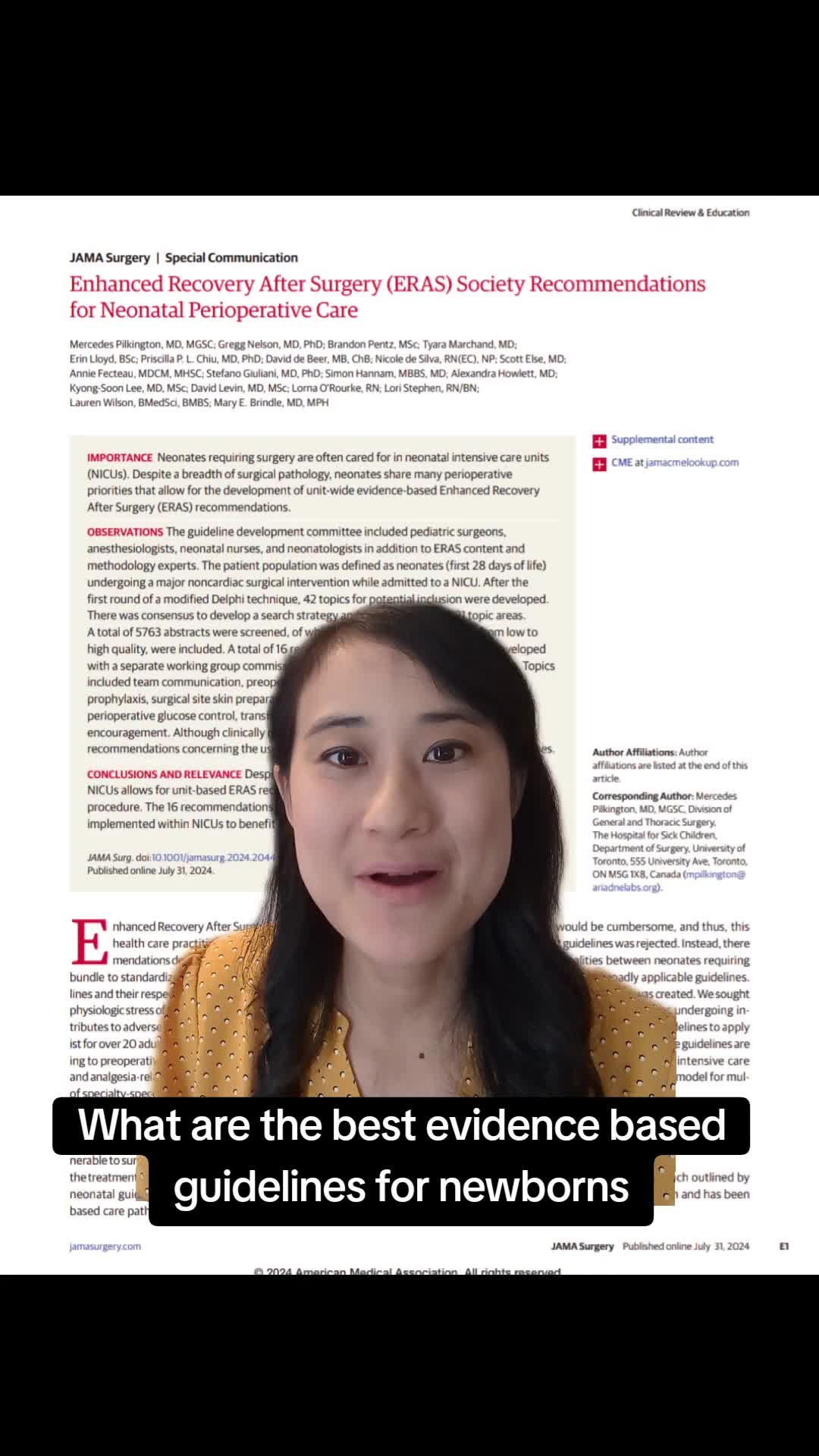
Enhanced Recovery After Surgery (ERAS) Society Recommendations for Neonatal Perioperative Care
Watch →
Mercedes Pilkington, Gregg Nelson, Brandon Pentz, Tyara Marchand, Erin Lloyd, Priscilla P. L. Chiu, David de Beer, Nicole de Silva, Scott Else, Annie Fecteau, Stefano Giuliani, Simon Hannam, Alexandra Howlett, Kyong-Soon Lee, David Levin, L
video0:59 · Oct 2024
Enhanced Recovery After Surgery (ERAS) Society Recommendations for Neonatal Perioperative Care
Read →
Mercedes Pilkington, Gregg Nelson, Brandon Pentz, Tyara Marchand, Erin Lloyd, Priscilla P. L. Chiu, David de Beer, Nicole de Silva, Scott Else, Annie Fecteau, Stefano Giuliani, Simon Hannam, Alexandra Howlett, Kyong-Soon Lee, David Levin, L
article · Oct 2024
Quality Improvement1 item
Reducing Unplanned Intubations in the Neonatal Intensive Care Unit After Children's Surgery
Watch →
New article you should know by Dr. Cecilia Gigena from the Journal of Pediatric Surgery
"Reducing Unplanned Intubations in the Neonatal Intensive Care Unit After Children's Surgery: A Quality Improvement Project"
Authors: Peter Juvile
video0:53 · Jun 2024
Summaries and takeaways+ Show
Summary of this collection+ Show
Key points, with the moment each was said+ Show
Featured picks for families are being prepared — the summaries above are written for you.
Takeaways+ Show
Congenital diaphragmatic hernia (CDH) occurs in approximately 1:3,000–4,000 pregnancies, typically diagnosed at the 20-week anatomy scan when the stomach appears in the same plane as the heart [e303-c1, e303-c2]. CDH represents a growth arrest of both lungs at 14–15 weeks gestation, with the ipsilateral side more severely affected; it is a field defect affecting the entire foregut from pharynx to ligament of Treitz [e303-c3, e303-c5, e303-c49]. At birth, lungs are affected by pulmonary hypoplasia and altered pulmonary vascular resistance . CDH is a physiologic emergency but not a surgical emergency; babies should be born at full-service children's facilities with ECMO capability, though only 10–15% will require ECMO [e303-c6, e303-c9]. Antenatal interventions remain experimental, and cesarean section is not indicated for CDH alone [e303-c7, e303-c8]. Overall survival to teenage years is 80–85% . Management centers on gentle ventilation (high rate, low pressure, permissive hypercapnia), preductal oximetry targets, and avoiding lung injury [e303-c22, e303-c23, e303-c27]. ECMO indication is oxygenation index >40 for ≥4 hours when end organs (assessed by urine output) are inadequately perfused [e303-c19, e303-c20, e303-c21]. Repair timing is when babies are stable on minimal ventilator settings, typically 3–4 days for non-ECMO patients . Thoracoscopic repair offers excellent visualization but carries ~25% recurrence risk; open subcostal approach remains standard [e303-c60, e303-c61, e303-c63]. Long-term sequelae include foregut dysmotility (not true reflux), neurodevelopmental issues, chest wall asymmetry, and scoliosis, necessitating lifelong multidisciplinary follow-up [e303-c77, e303-c82, e303-c84, e303-c85, e303-c87].
- CDH is a physiologic emergency requiring gentle ventilation (high rate, low pressure, permissive hypercapnia) guided by preductal oximetry; avoid aggressive ventilation that destroys hypoplastic lungs.
- ECMO is indicated when oxygenation index exceeds 40 for ≥4 hours and end organs (assessed by urine output) are inadequately perfused despite optimal care; 10–15% of CDH babies require it.
- Repair timing is when babies are stable on minimal ventilator settings (typically 3–4 days for non-ECMO patients); operating on ECMO is rarely beneficial as the problem is lung growth arrest, not bowel in chest.
- Thoracoscopic repair offers excellent visualization but carries ~25% recurrence risk in stable patients; open subcostal approach with adequate exposure and tension-free closure (often requiring Gore-Tex patch) remains standard.
- CDH is a field defect causing lifelong foregut dysmotility, neurodevelopmental issues, chest wall asymmetry, and scoliosis; avoid fundoplication for dysmotility and provide multidisciplinary follow-up with PPI and surveillance for Barrett's esophagitis.
For patients & families
Congenital diaphragmatic hernia (CDH) happens in about 1 in 3,000–4,000 pregnancies and is usually found on the 20-week ultrasound when the baby's stomach appears next to the heart. The condition affects lung growth on both sides of the chest, though one side is more affected than the other. Doctors describe CDH as a medical emergency that requires careful planning but not immediate surgery. Most babies with CDH—about 80–85%—survive to become teenagers. Babies with CDH should be born at specialized children's hospitals equipped with advanced support systems; about 10–15% may need a heart-lung bypass machine called ECMO. The medical team focuses on keeping oxygen levels stable in the baby's brain, sometimes using gentler ventilator settings than traditional approaches. Surgery to repair the diaphragm typically happens after a few days once the baby is stable. CDH is part of a broader condition affecting the digestive system, so children often need feeding support and long-term follow-up care addressing growth, development, and digestive function.
Congenital diaphragmatic hernia (CDH) happens in about 1 in 3,000–4,000 pregnancies and is usually found on the 20-week ultrasound when the baby's stomach appears next to the heart. The condition affects lung growth on both sides of the chest, though one side is more affected than the other. Doctors describe CDH as a medical emergency that requires careful planning but not immediate surgery. Most babies with CDH—about 80–85%—survive to become teenagers. Babies with CDH should be born at specialized children's hospitals equipped with advanced support systems; about 10–15% may need a heart-lung bypass machine called ECMO. The medical team focuses on keeping oxygen levels stable in the baby's brain, sometimes using gentler ventilator settings than traditional approaches. Surgery to repair the diaphragm typically happens after a few days once the baby is stable. CDH is part of a broader condition affecting the digestive system, so children often need feeding support and long-term follow-up care addressing growth, development, and digestive function.
The doctors in this collection+ Show
All expert statements+ Show
Every expert statement below comes from the recorded discussions, with its speaker and moment.
Congenital Diaphragmatic Hernia with Dr. Charlie Stolar
CDH occurs in approximately 1 out of every 3,000-4,000 pregnancies
epidemiologicalCharlie Stolar2:45 ↗
CDH diagnosis is typically made at the 20-week anatomy scan when ultrasonographers see the stomach in the same cross-sectional plane as the heart
clinicalCharlie Stolar3:37 ↗
CDH represents a growth arrest of both lungs, with the ipsilateral side more severely affected than the contralateral side
clinicalCharlie Stolar4:14 ↗
At birth, CDH lungs are affected by a mix of pulmonary hypoplasia and altered pulmonary vascular resistance with altered transitional circulation
clinicalCharlie Stolar4:23 ↗
CDH is a field defect; the most common neonatal comorbidity is foregut motility difficulty
clinicalCharlie Stolar4:39 ↗
CDH is a medical physiologic emergency but not a surgical emergency
clinicalCharlie Stolar5:00 ↗
The diagnosis of CDH alone is not an indication for cesarean section; elective spontaneous vaginal delivery is recommended assuming no obstetric issues
guidelineCharlie Stolar5:24 ↗
Antenatal interventions for CDH are no better than investigational and experimental at best
opinionCharlie Stolar6:35 ↗
Babies with CDH should be born at a full-service children's facility with ECMO capability; maybe 10-15% will benefit from ECMO
guidelineCharlie Stolar7:23 ↗
In single-center experiences, presence of liver in the chest or stomach in the chest is of no prognostic value
clinicalCharlie Stolar8:31 ↗
Lung-to-head ratio is of limited prognostic value except when very low (less than 0.8), where prognosis is concerning
clinicalCharlie Stolar8:42 ↗
Associated congenital heart disease and central nervous system abnormalities augur for poor prognosis
clinicalCharlie Stolar9:07 ↗
If shown 100 children with CDH, 80-85% will survive to become teenagers
epidemiologicalCharlie Stolar10:13 ↗
Antenatal steroids have tremendous value for preterm labor under 35 weeks but most CDH babies are near-term (37-39 weeks) where steroid role is arguable
clinicalCharlie Stolar10:37 ↗
Exit to ECMO for CDH is nonsense; it moves the goalposts on almost certainly non-viable babies
opinionCharlie Stolar12:06 ↗
We are born with about 1/2 to 2/3 of our full complement of alveoli and can grow the balance sometime after birth
clinicalCharlie Stolar13:00 ↗
Initial evaluation of newborn with CDH includes looking for morphology, associated anomalies, respiratory distress, pre- and post-ductal oxygen gradients, and early cardiac echo for right heart function
clinicalCharlie Stolar14:45 ↗
Not every baby with CDH needs or is a candidate for ECMO; approximately 5% have insufficient lung to support life based on inability to saturate preductal blood
clinicalCharlie Stolar15:55 ↗
ECMO is a drug delivery system for oxygen; indication is when end organs aren't getting enough oxygen despite best care
clinicalCharlie Stolar17:06 ↗
The best way to assess end-organ function is urine output
clinicalCharlie Stolar17:44 ↗
ECMO indication is typically oxygenation index in excess of 40 for 4 hours or more
guidelineCharlie Stolar18:21 ↗
All therapy is guided by preductal oximetry, not postductal; if preductal saturation is 90% (PaO2 ~65 torr), the brain is doing fine with fetal hemoglobin
clinicalCharlie Stolar19:06 ↗
When managing dropping preductal saturation, first ensure adequate hemoglobin and circulating volume, then increase FiO2 or ventilator pressure, but avoid trying to control PCO2 as this will destroy the lungs
clinicalCharlie Stolar20:25 ↗
Neonatal ventilators would be thrown out as lethal devices if someone tried to invent them today
opinionCharlie Stolar21:38 ↗
CDH babies are not paralyzed during ventilation; minimal sedation is used and babies should be awake and breathing spontaneously
clinicalCharlie Stolar21:56 ↗
Initial conventional ventilator settings (IMV rate ~40, peak pressure 25-28, PEEP ~5) are not tolerated by most CDH babies
clinicalCharlie Stolar22:15 ↗
Unconventional ventilation mode for CDH uses high rate (100 breaths/min), low peak pressure (turned down to zero due to stacking), and high gas flow rate with permissive hypercapnia
clinicalCharlie Stolar22:53 ↗
High-frequency oscillatory ventilation (HFOV) as rescue therapy rarely spares CDH babies from ECMO; when they get out the oscillator, it's time to prime an ECMO circuit
clinicalCharlie Stolar24:30 ↗
Nitric oxide is a waste of money for CDH; it's terrific for premature babies with immature lung disease but of no value in CDH
opinionCharlie Stolar25:45 ↗
The best drug for CDH is oxygen
opinionCharlie Stolar26:07 ↗
What's new+ Show