

Educational content from recorded physician discussions — not medical advice. Always talk to your child's care team about your child's situation.
Content of this collection
Tools
0 items
In-depth Review
1 item

Digestive Foreign Bodies: Diagnosis and Management
Listen →
Kids will eat any and everything if given the chance. But what if they eat something like a coin or worse - a button battery? In this episode, we brought in a pediatric gastroenterologist to talk about the treatment and management of digest
podcast17:54 · Mar 2021
Work-up and Treatment
0 items
Updates
2 items

Update Course 2021: APSA PDC UPDATES
Watch →
In this APSA PDC session, the Professional Development Committee provides competency maintenance needs for practicing pediatric surgeons and pediatric surgery trainees. Hosted by Dr. Marjorie Arca, MD
video · May 2022
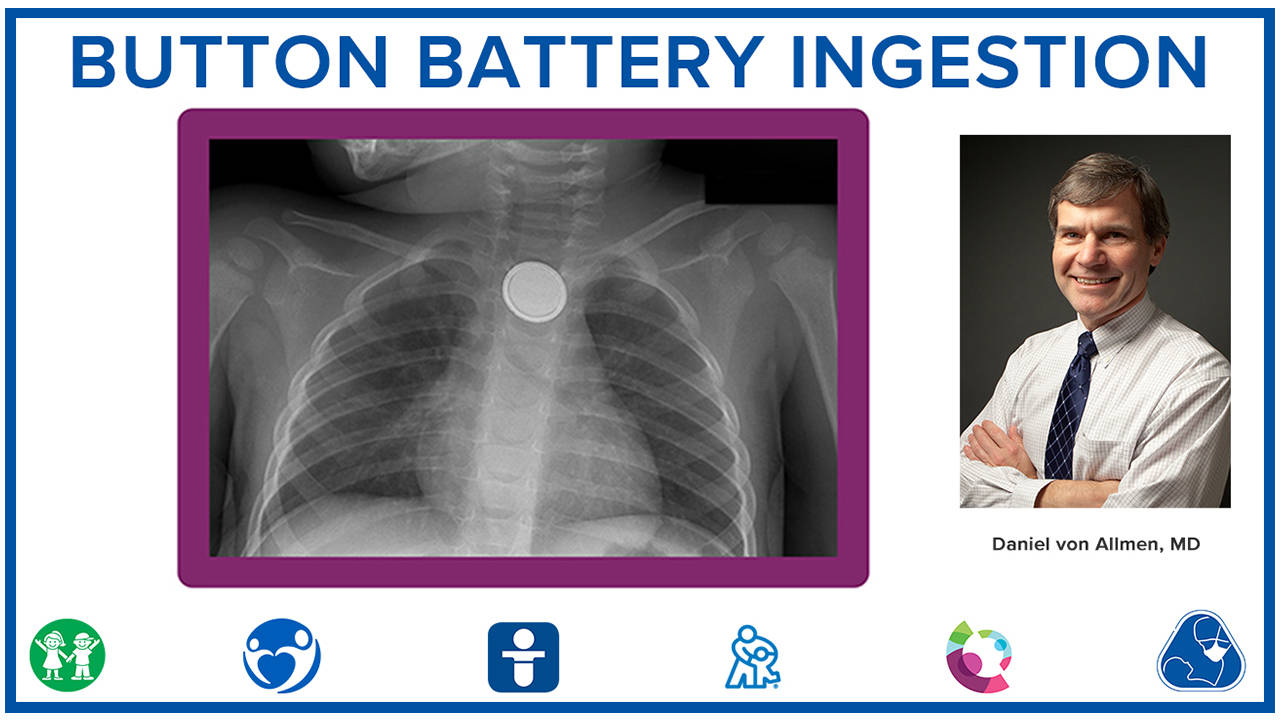
Button Battery Ingestion
Watch →
At the 7th Annual Pediatric Surgery Update Course, Dr. Daniel von Allmen discusses management after button battery ingestion.
video14:28 · Mar 2020
Summaries and takeaways+ Show
Summary of this collection+ Show
Key points, with the moment each was said+ Show
Featured picks for families are being prepared — the summaries above are written for you.
Takeaways+ Show
Button battery ingestions represent an escalating emergency, with ED visits doubling and serious complications increasing nearly sevenfold. The 20–25 mm lithium batteries (3 V) account for 90% of severe outcomes. Pathophysiology is caustic hydroxide-mediated injury, not mechanical or electrical, causing rapid pH elevation and liquefactive necrosis within 2–6 hours. Witnessed esophageal batteries mandate OR removal within 2 hours; trauma activation protocols reduce door-to-OR time to <30 minutes. Aortoenteric fistula is the leading cause of mortality (46%), occurring up to 2 weeks post-removal, prompting some to advocate post-removal MRI. Complications include perforation, stricture, TEF, and vocal cord paralysis. Controversy exists around gastric batteries: poison.gov permits observation, but fatal cases drive many to retrieve immediately if reachable. Endoscopy is preferred even when batteries reach the stomach, as significant esophageal injury may coexist. Emerging animal data suggest 0.25% acetic acid neutralization, though not yet standard. Pre-hospital honey (≥12 months) or sucralfate (<12 months) may mitigate injury during transfer.
- 20–25 mm lithium batteries cause 90% of severe outcomes via hydroxide-mediated caustic injury, not electrical burns, with complications peaking within hours.[e2300-c9][e2300-c11][e3776-c19]
- Aortoenteric fistula accounts for 46% of button battery deaths and can occur up to 2 weeks post-removal, driving consideration of post-removal MRI.[e2300-c13][e2300-c15][e2300-c16]
- Esophageal batteries require OR removal within 2 hours; trauma activation reduces door-to-OR time to <30 minutes.[e3776-c18][e2300-c17]
- Controversy persists on gastric batteries: guidelines permit observation, but fatal cases prompt many to retrieve immediately if endoscopically reachable.[e3776-c19][e3776-c21]
- Pre-hospital honey (≥12 months) or sucralfate (<12 months) may reduce injury during transfer; 0.25% acetic acid neutralization shows promise in animal models.[e5412-c23][e5412-c24][e2300-c27]
For patients & families
Button batteries—the small, round batteries found in greeting cards, remotes, and toys—are causing more emergency room visits and serious injuries in children. The most dangerous are the larger 20–25 millimeter lithium batteries, which account for 90% of serious outcomes. These batteries cause rapid chemical burns by creating hydroxide ions that raise tissue pH, not by leaking acid or delivering electric shocks. Injuries can include holes in the esophagus, scarring, connections forming between the airway and food pipe, and damage to blood vessels—including the aorta—which can be fatal even up to two weeks after the battery is removed. Doctors now treat witnessed esophageal button batteries as emergencies, removing them within two hours. Coins are the most common swallowed objects overall, and most foreign bodies that reach the stomach will pass on their own. Magnets are another growing concern, especially when more than one is swallowed, as they can stick together through the bowel wall. Physicians use X-rays to locate objects and endoscopy to remove those that pose risk.
Button batteries—the small, round batteries found in greeting cards, remotes, and toys—are causing more emergency room visits and serious injuries in children. The most dangerous are the larger 20–25 millimeter lithium batteries, which account for 90% of serious outcomes. These batteries cause rapid chemical burns by creating hydroxide ions that raise tissue pH, not by leaking acid or delivering electric shocks. Injuries can include holes in the esophagus, scarring, connections forming between the airway and food pipe, and damage to blood vessels—including the aorta—which can be fatal even up to two weeks after the battery is removed. Doctors now treat witnessed esophageal button batteries as emergencies, removing them within two hours. Coins are the most common swallowed objects overall, and most foreign bodies that reach the stomach will pass on their own. Magnets are another growing concern, especially when more than one is swallowed, as they can stick together through the bowel wall. Physicians use X-rays to locate objects and endoscopy to remove those that pose risk.
The doctors in this collection+ Show
All expert statements+ Show
Every expert statement below comes from the recorded discussions, with its speaker and moment.
Button Battery Ingestion
Button battery ingestions are becoming more frequent, with national data showing increasing numbers of emergency department visits.
epidemiologicalDan0:01 ↗
Button batteries are ubiquitous in greeting cards, remotes, and similar devices.
clinicalDan0:50 ↗
A ring around the edge of a circular object on X-ray indicates it is a button battery, not a quarter.
clinicalDan1:30 ↗
Foley catheter technique may work for button battery removal when operating room access is delayed and symptom duration is short.
clinicalDan2:10 ↗
NASPGHAN and the GI group developed guidelines for button battery management with zero input from surgeons.
guidelineMark3:44 ↗
Guidelines mandate serial MRIs for button battery cases due to concern for vascular injury.
guidelineMark4:10 ↗
The number of ED visits for button battery ingestion has doubled according to Colorado study data.
Host summaryDan summarizing the discussion — not the host's own clinical position4:41 ↗
The rate of significant complications from button batteries has increased almost sevenfold.
Host summaryDan summarizing the discussion — not the host's own clinical position5:00 ↗
90% of serious outcomes occur with 20-25 millimeter batteries.
Host summaryDan summarizing the discussion — not the host's own clinical position5:15 ↗
20-25 millimeter batteries are lithium batteries that tend to be 3 volt rather than 1.5 volt.
clinicalDan5:30 ↗
The pathophysiology is caustic injury from hydroxide ions that rapidly raise tissue pH, not mechanical erosion or electricity.
clinicalDan5:45 ↗
Complications include esophageal perforation, stricture, tracheoesophageal fistula, and vocal cord paralysis not associated with perforation.
clinicalDan6:10 ↗
Aortoenteric fistula is the most common cause of mortality in the national data bank, accounting for 46% of mortalities.
Host summaryDan summarizing the discussion — not the host's own clinical position6:35 ↗
Another 29% of mortalities involved some sort of vascular compromise.
Host summaryDan summarizing the discussion — not the host's own clinical position7:00 ↗
Aortoenteric fistula can occur up to 2 weeks post-removal of the battery.
Host summaryDan summarizing the discussion — not the host's own clinical position7:15 ↗
Authors of the Colorado paper recommend MRI after battery removal to assess potential impact on surrounding vasculature.
Host summaryDan summarizing the discussion — not the host's own clinical position7:35 ↗
Using trauma one system activation reduced time from door to OR from 1.5 hours to less than 30 minutes.
clinical8:47 ↗
Some authors advocate scoping patients even when battery is in the stomach because patients can have significant esophageal injuries with the battery having passed on.
Host summaryDan summarizing the discussion — not the host's own clinical position9:28 ↗
Poison.gov recommendations say you do not need to scope if the battery is in the stomach.
Host summaryMark summarizing the discussion — not the host's own clinical position9:56 ↗
For minor mucosal injury on endoscopy, symptomatic follow-up without intervention is appropriate.
opinionDan10:24 ↗
For circumferential erosions that look bad, re-scoping to look for stricture formation is recommended.
opinionDan10:43 ↗
If patients become symptomatic after injury, esophagram can assess for narrowing or stricture.
clinicalDan10:54 ↗
Endoscopy advantage over esophagram is ability to reassess appearance and dilate if needed.
clinicalDan11:32 ↗
If already performing endoscopy and capable of removing battery from stomach, removal is advocated.
opinionDan12:27 ↗
There is GI literature about removing 20 millimeter batteries from stomach because they may not pass the ileocecal valve.
Host summaryDan summarizing the discussion — not the host's own clinical position12:50 ↗
20-25 millimeter batteries are the ones of most concern.
clinical13:01 ↗
There is evolving work in animal models using 0.25% acetic acid applied to the area of injury to neutralize it.
clinical13:34 ↗
Acetic acid for neutralization is not something off the shelf and requires pharmacy coordination.
clinical13:58 ↗
Digestive Foreign Bodies: Diagnosis and Management
The majority of ingested foreign bodies eventually make it into the stomach, but emergency removal is most concerning for esophageal foreign bodies.
Host summaryRae Hanke summarizing the discussion — not the host's own clinical position1:43 ↗
Esophageal foreign bodies commonly lodge at three sites: high at the cricopharyngeus, where the aorta crosses over (less common), and most commonly at the lower esophageal sphincter.
clinicalVince Mkotta2:04 ↗
What's new+ Show