
 Dr. Amr Moursi
Epilepsy
Everything in the library about epilepsy — built automatically from the recorded discussions that name it
Educational content from recorded physician discussions — not medical advice. Always talk to your child's care team about your child's situation.
Content of this collection
Fundamentals
1 item

Epilepsy Surgery Outcomes Explained 🧠
Watch →
How do surgeons evaluate outcomes after epilepsy surgery?
The Engel Classification provides a standard framework for describing postoperative seizure outcomes. In this short reel, I break down its key categories simply and quickly.
#
video2:16 · Jul 2026
Surgical Management
1 item
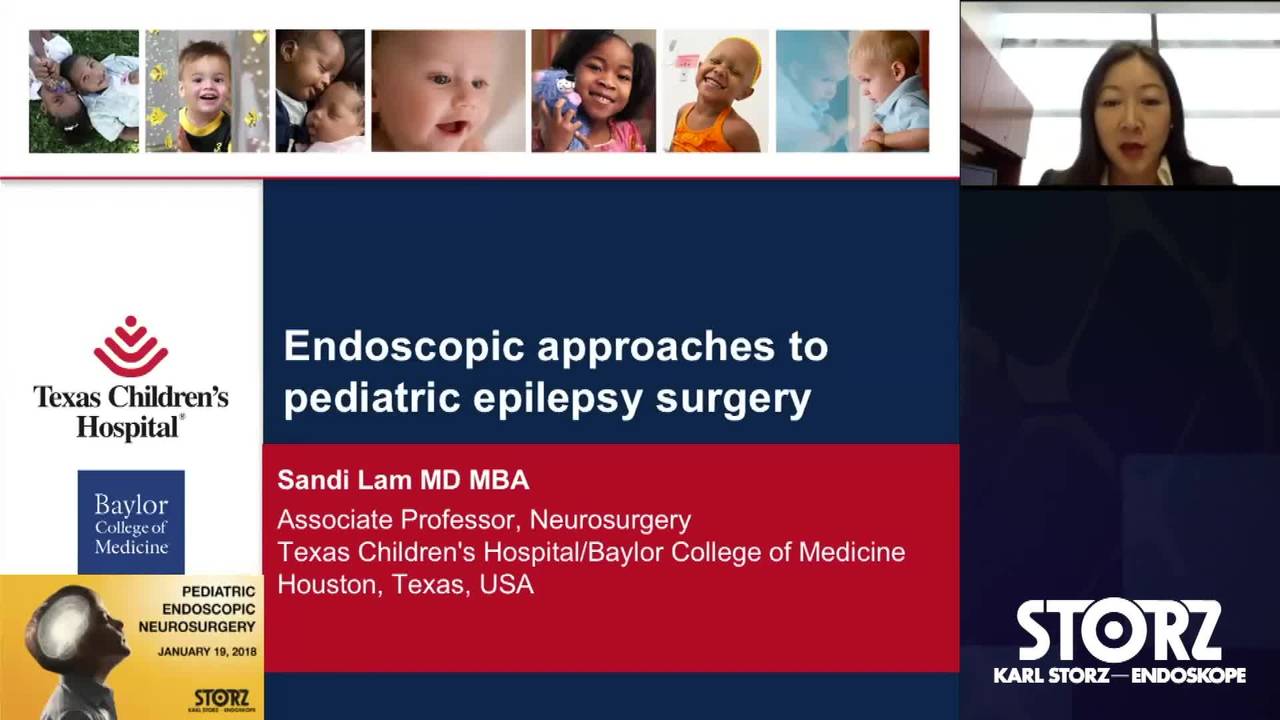
Endoscopic Approaches to Pediatric Epilepsy Surgery: Pediatric Endoscopic...
Watch →
As a part of the Pediatric Endoscopic Neurosurgery 2018 Course, Dr. Sandi Lam discusses endoscopic approaches to pediatric epilepsy surgery. She further details the rationale for epilepsy surgery, maximally invasive approaches versus minima
video23:38 · Sep 2018
Case-Based Learning
1 item

Epilepsy Exam Questions for Neurosurgeons | MCQs, Concepts and Key Topics - part 1 out 3
Watch →
Epilepsy surgery has a reputation for being one of the hardest functional topics in the exam.
It is not impossible—it is simply long.
The best way to understand it is to follow the same structure used when working up a real patient:
Diag
video · Jul 2026
Summaries and takeaways+ Show
The doctors in this collection+ Show
All expert statements+ Show
Every expert statement below comes from the recorded discussions, with its speaker and moment.
Endoscopic Approaches to Pediatric Epilepsy Surgery: Pediatric Endoscopic...
Recurrent seizures and long-term anti-epileptic drug therapy have detrimental effects on the developing brain in children.
clinicalSandy Lamb0:34 ↗
The International League Against Epilepsy has a consensus for recommending early surgical intervention in pediatric epilepsy when it is safe to do so.
guidelineSandy Lamb2:00 ↗
Minimally invasive approaches for epilepsy surgery must achieve complete disconnection and offer outcomes similar to maximally invasive approaches.
clinicalSandy Lamb2:30 ↗
At Texas Children's Hospital, Dan Curry has been a pioneer in stereotactic laser ablation for epilepsy surgery.
clinicalSandy Lamb3:20 ↗
Cost comparison using national databases showed that minimally invasive laser ablation for hamartomas had lower hospitalization costs compared to open surgery.
epidemiologicalSandy Lamb4:40 ↗
In a comparison of approximately 10 corpus callosotomies, laser ablation versus open craniotomy showed no difference in length of stay or discharge destination.
clinicalSandy Lamb6:20 ↗
With laser ablation for corpus callosotomy, most children needed to go to rehabilitation, three children needed re-operations, and one had transient hemiparesis.
clinicalSandy Lamb7:00 ↗
Laser ablation for corpus callosotomy requires multiple trajectories because the anatomy of the corpus callosum is curved, making it difficult to control straight-line catheters.
clinicalSandy Lamb7:40 ↗
Endoscopic corpus callosotomy has been described in cadaveric studies and clinical series by groups including Matt Smith in Saint Louis.
clinicalSandy Lamb8:40 ↗
The endoscopic-assisted approach for corpus callosotomy uses three hands, similar to transsphenoidal surgery, which reduces the learning curve compared to fully endoscopic techniques.
clinicalSandy Lamb9:20 ↗
For endoscopic corpus callosotomy, navigation is performed in real time using a straight endoscope, and the surgical steps include interhemispheric approach, identification of pericallosal arteries and ACAs, and white matter disconnection from rostrum to splenium.
clinicalSandy Lamb10:00 ↗
Postoperative DTI imaging was used initially to confirm complete disconnection after endoscopic corpus callosotomy.
clinicalSandy Lamb14:10 ↗
Hemispherectomy techniques have evolved over time from anatomical to functional hemispherectomy to functional hemispherotomy, with approaches varying from lateral to paramedian vertical.
clinicalSandy Lamb15:00 ↗
Al Cohen described cadaveric studies for endoscopic hemispherectomy using two burr holes (frontal and occipital), with the frontal approach providing a view at the foramen of Monro and the occipital approach into the atrium providing a view of the temporal horn.
clinicalSandy Lamb15:50 ↗
Dr. Sood and Dr. Chandra have described small series of endoscopic approaches for both callosotomies and hemispherectomies.
clinicalSandy Lamb17:30 ↗
The Texas Children's Hospital team developed a single-burr-hole paramedian vertical approach for endoscopic hemispherectomy, with a fallback plan to convert to open approach or middle temporal gyrus approach if needed.
clinicalSandy Lamb16:40 ↗
In cadaveric studies, the single-burr-hole approach allowed visualization of the corpus callosum, lateral ventricle body, anterior corpus callosum, splenium, choroid plexus, atrium, temporal horn after insular cut, and enabled hippocampectomy.
clinicalSandy Lamb18:20 ↗
Case selection is very important when developing new endoscopic techniques, and surgeons must have extensive experience and comfort with open surgeries and be very familiar with the anatomy before attempting to minimize the access corridor.
opinionSandy Lamb19:10 ↗
The first endoscopic hemispherectomy patient at Texas Children's Hospital was a post-stroke epilepsy patient with significant tissue loss, providing good initial conditions for the new technique.
clinicalSandy Lamb20:00 ↗
Preliminary results from the small case series show that children undergoing endoscopic hemispherectomy mobilize quicker, have less soft tissue edema, and recover faster than with open craniotomy.
clinicalSandy Lamb21:40 ↗
Anesthesia colleagues did not see the need to transfuse blood during endoscopic hemispherectomy cases, and blood loss was much less than with open craniotomies for hemispherectomies.
clinicalSandy Lamb22:10 ↗
Seizure outcomes with endoscopic hemispherectomy have been comparable to open craniotomy so far, though long-term follow-up and more patients are needed.
clinicalSandy Lamb22:40 ↗
Operative time for endoscopic hemispherectomy has been comparable to open craniotomy.
clinicalSandy Lamb23:10 ↗
Epilepsy Exam Questions for Neurosurgeons | MCQs, Concepts and Key Topics - part 1 out 3
Epilepsy surgery is one of the hardest functional topics in the exam
opinion0:00 ↗
The best way to understand epilepsy surgery is to follow the structure: Diagnose, Investigate, Operate
opinion0:00 ↗
Two seizures are required to diagnose epilepsy
guideline0:00 ↗
Two failed appropriate drugs are required before referring for surgical assessment
guideline0:00 ↗
Absence epilepsy has a characteristic 3 Hz spike-and-wave pattern on EEG
clinical0:00 ↗
Lennox-Gastaut syndrome has a slow 1.5-2.5 Hz spike-and-wave pattern on EEG
clinical0:00 ↗
Juvenile myoclonic epilepsy has a 4-6 Hz polyspike-and-wave pattern on EEG
clinical0:00 ↗
What's new+ Show