
 StayCurrentMD
Cryptorchidism
Everything in the library about cryptorchidism — built automatically from the recorded discussions that name it
Educational content from recorded physician discussions — not medical advice. Always talk to your child's care team about your child's situation.
Content of this collection
Evidence & Research
2 items

Age at Orchiopexy JPS Review
Watch →
This video reviews an article from JPS that discusses optimal age for orchiopexy
video · Feb 2019
Quick Literature Updates Ep 25
Watch →
We’re back with 25th episode of "Quick Literature Updates" the podcast series that delivers the latest updates in pediatric surgery literature in a quick and digestible format. In each episode, we review articles covering the most interesti
video · Dec 2025
In-Depth Reviews
1 item
Cryptorchidism Rapid Fire Session: Update Course 2015
Watch →
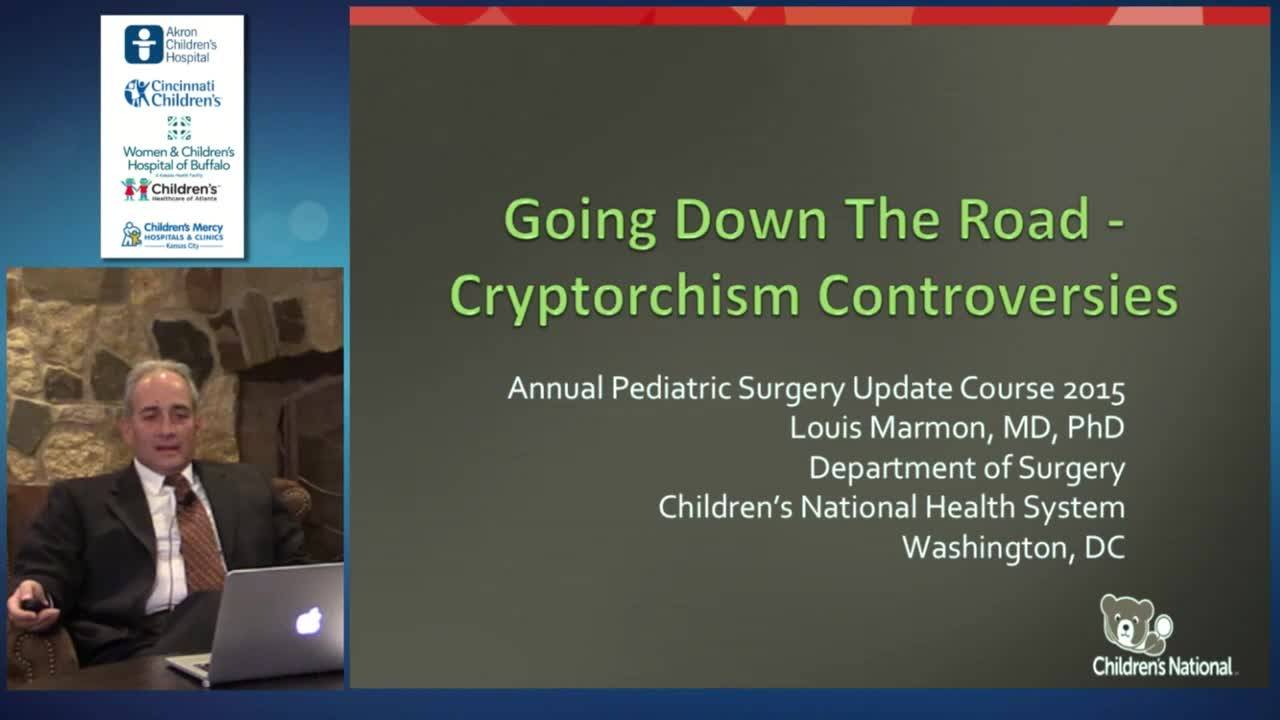
During the 3rd Annual Stay Current in Pediatric Surgery Update Course in 2015, Dr. Louis Marmon, a Pediatric Surgeon at Children’s National Medical Center, gives a presentation on cryptorchidism. Discussion includes congenital and acquired
video6:03 · Jan 2019
Summaries and takeaways+ Show
The doctors in this collection+ Show
All expert statements+ Show
Every expert statement below comes from the recorded discussions, with its speaker and moment.
Cryptorchidism Rapid Fire Session: Update Course 2015
Cryptorchidism is one of the most common pediatric disorders of the male endocrine glands and the most common genital disorder identified at birth.
epidemiological0:00 ↗
There are two types of cryptorchidism: congenital (found at birth) and acquired (testicles previously descended but can no longer be brought down without discomfort).
clinical1:00 ↗
Treatment of cryptorchidism reduces risks including impaired fertility, testicular malignancy, risk of torsion, and treats associated inguinal hernia.
clinical2:00 ↗
The actual mechanism of action of hormonal therapy agents for cryptorchidism is unknown.
clinical3:00 ↗
Published studies on hormonal therapy included multiple treatment strategies with different doses and intervals, none showing good response rates or demonstrable long-term benefits.
clinical3:20 ↗
Hormonal therapy should not be used to induce testicular descent due to low response rates and lack of evidence for long-term efficacy.
guideline4:00 ↗
70% of undescended testicles are palpable, though they may not be palpable during examination while the child is awake but are usually palpable under anesthesia.
clinical4:20 ↗
Ultrasound has a sensitivity of only 45% and specificity of only 78% in determining testicle location and size.
clinical4:50 ↗
Ultrasound cannot identify intra-abdominal testicles.
clinical5:10 ↗
Other imaging modalities are expensive, require anesthesia, or irradiate tissues, and no radiologic test is 100% accurate to determine whether a testicle is absent.
clinical5:20 ↗
Surgical exploration (diagnostic laparoscopy or open exploration) must be performed on all non-palpable unilateral and many bilateral cryptorchid patients.
guideline5:50 ↗
Imaging should not be performed for cryptorchidism as it is not helpful and can actually delay treatment.
guideline6:20 ↗
There is no advantage for laparoscopic versus open exploration for intra-abdominal testicles.
clinical6:40 ↗
For salvageable intra-abdominal testicles, three surgical options exist: primary orchiopexy, one-stage Fowler-Stevens, or two-stage Fowler-Stevens.
clinical7:00 ↗
The decision tree for intra-abdominal testicles prioritizes sparing testicular vessels if possible.
clinical7:30 ↗
There is no apparent advantage of one-stage versus two-stage Fowler-Stevens procedure when testicular vessels cannot be spared.
clinical6:03 ↗
Orchiectomy may be prudent in the presence of a normal contralateral descended testicle.
opinion6:03 ↗
Most of the time the testes can be brought down without needing to divide the testicular vessels.
opinion4:58 ↗
For prepubertal patients (e.g., 10 years old), orchiopexy should be attempted; for pubertal patients (e.g., 14 years old), orchiectomy is preferred; 12 years old is a difficult decision point.
opinion5:15 ↗
The teaching is that if the patient is prepubertal, orchiopexy can be attempted, but if going through puberty, orchiectomy should be performed.
guideline5:17 ↗
Quick Literature Updates Ep 25
Wertheim et al. performed a systematic review of management and outcomes of pediatric lymphatic malformations, published by the APSA Outcomes and Evidence-Based Practice Committee.
host_summary0:16 ↗
The systematic review focused on 200 articles published from 1990 to 2021.
host_summary0:42 ↗
Sclerotherapy had a success rate of over 90% for macrocystic lymphatic malformation lesions.
host_summary0:52 ↗
Sirolimus is helpful for extensive lymphatic malformations that are refractory to surgery and/or sclerotherapy.
host_summary1:00 ↗
Sirolimus is used as an initial treatment for extensive lymphatic malformations that compromise the airway.
host_summary1:08 ↗
Small asymptomatic lymphatic malformation lesions can be observed.
host_summary1:16 ↗
Large symptomatic lymphatic malformation lesions need to be divided into macrocystic, microcystic, or mixed lesions for treatment planning.
host_summary1:19 ↗
For localized lymphatic malformation lesions, surgery or sclerotherapy is effective.
host_summary1:19 ↗
Mo et al. performed a retrospective cohort analysis of the NSQIP pediatric database looking at all pediatric patients who underwent G-tube placement in 2023.
host_summary1:23 ↗
G-tube placement made up 5.3% of all cases submitted to NSQIP pediatric.
host_summary1:48 ↗
What's new+ Show