
 StayCurrentMD
Abusive Head Trauma
Everything in the library about abusive head trauma — built automatically from the recorded discussions that name it
Educational content from recorded physician discussions — not medical advice. Always talk to your child's care team about your child's situation.
Content of this collection
Diagnosis & Workup
2 items

Escalation Injuries: Pediatric Trauma Series 2017
Watch →
Experts across the country joined for this three part series on issues in pediatric trauma, from evaluation of the pediatric abdomen following blunt trauma, standardized screening for non-accidental trauma and pediatric gun violence.This se
video25:14 · Sep 2018
Pediatric Trauma Screening For Non-Accidental Trauma: Pediatric Trauma Series...
Watch →
Experts across the country joined for this three part series on issues in pediatric trauma, from evaluation of the pediatric abdomen following blunt trauma, standardized screening for non-accidental trauma and pediatric gun violence. This s
video1:04:09 · Sep 2018
Evidence & Research
1 item

JPS Journal Club: July 2019 Part 3
Watch →
The last of three videos discussing the trauma-heavy July issue of the Journal of Pediatric Surgery. In this episode, we discuss the position statement from @American Pediatric Surgical Association pertaining to child absue. Find the articl
video · Aug 2019
Summaries and takeaways+ Show
The doctors in this collection+ Show
All expert statements+ Show
Every expert statement below comes from the recorded discussions, with its speaker and moment.
Pediatric Trauma Screening For Non-Accidental Trauma: Pediatric Trauma Series...
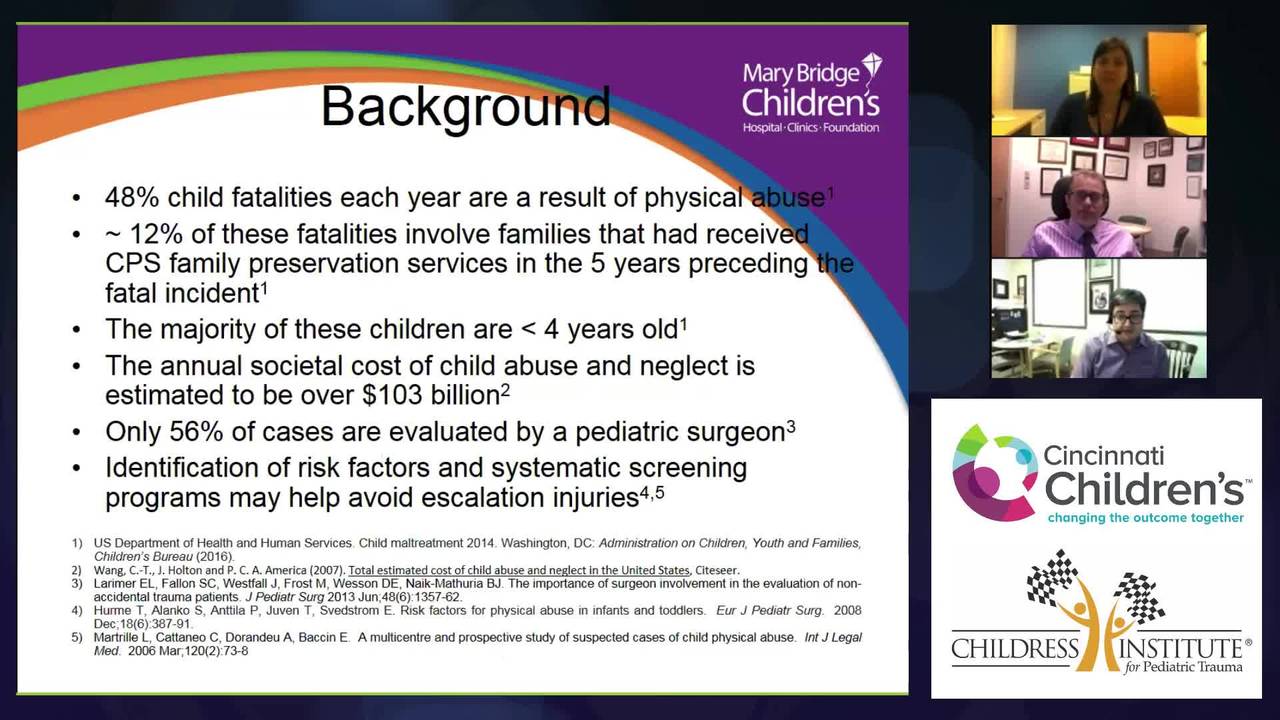
48% of child fatalities each year are a result of physical abuse
host_summaryTony Escobar3:06 ↗
Approximately 12% of child abuse fatalities involve families that had CPS intervention in the last 5 years prior to the fatality, with the majority of these children less than 4 years of age
host_summaryTony Escobar3:15 ↗
In Carol Jenny's study, approximately 30% of children with abusive head trauma had NAT not originally considered or recognized by physicians
host_summaryTony Escobar5:30 ↗
Kate Dean's group demonstrated that patients with recurrent NAT had significantly higher mortality than during their first presentation
host_summaryTony Escobar5:50 ↗
In Mary Bridge's retrospective cohort, 89% of NAT cases had inconsistent or missing history, 79% had unwitnessed injuries, and almost 40% of patients had a prior ED visit
clinicalTony Escobar11:20 ↗
60% of NAT patients with prior ED visits were less than a year of age
clinicalTony Escobar11:50 ↗
41% to 73% of NAT patients were missing social history data in the chart
clinicalTony Escobar12:10 ↗
Perineal bruising or injury was found in a small number of patients, but the majority were less than 4 years of age and there was significantly increased risk of mortality and morbidity with this finding
clinicalTony Escobar12:50 ↗
60% of NAT patients less than a year of age had fractures, with a fraction having undiagnosed healing fractures in other sites
clinicalTony Escobar13:20 ↗
A third of NAT patients had rib fractures, which were significantly associated with severe injury (ISS ≥16) and other undiagnosed healing fractures
clinicalTony Escobar14:00 ↗
In the retrospective cohort, 9 patients died, and 2/3 of those had a prior ED visit
clinicalTony Escobar14:30 ↗
After implementing standardized NAT screening at Mary Bridge, ED length of stay did not change
clinicalTony Escobar19:40 ↗
After implementing standardized screening, the number of admissions went down, possibly because more standardized screening in the ER led to safer disposition planning and fewer medical holds
clinicalTony Escobar19:55 ↗
The use of head CT did not change after implementing the NAT screening protocol
clinicalTony Escobar19:10 ↗
The 10-4 clinical prediction rule (torso, ears, neck bruising in children <4 years, or any bruising in infants <4 months) is highly suspicious for NAT
host_summaryTony Escobar22:30 ↗
In the most recent systematic review of burns, up to 25% of children admitted to burn centers had been abused
host_summaryTony Escobar23:40 ↗
Greater than 95% of patients with intentional burns were aged less than 5 years
host_summaryTony Escobar24:05 ↗
Hollow viscous injuries, specifically duodenal injuries in children less than 4 years old, are highly suggestive of abuse
host_summaryTony Escobar25:40 ↗
Abusive abdominal injury can occur without external signs such as bruising
host_summaryTony Escobar26:15 ↗
Screening for elevated liver function tests is recommended, and if elevated, further axial imaging is recommended to evaluate for intraabdominal injury
host_summaryTony Escobar26:25 ↗
Frenulum tears in mobile children have equivalent incidence between accidental and non-accidental trauma, so in and of themselves there is not sufficient evidence to recommend a child abuse workup
host_summaryTony Escobar27:10 ↗
In a national study of primary care providers, PCPs often fail to report injuries concerning for child abuse to CPS due to familiarity with the family, perceived lack of value from CPS involvement, or use of their own alternative management plan
host_summaryKristen Crichton29:10 ↗
In a study of pediatric nurses, barriers to reporting included difficulty with cases that aren't clear cut, especially in small infants where injuries can be non-severe or non-specific
host_summaryKristen Crichton30:10 ↗
In a Dutch study of ED physicians, barriers included lack of time, fear of inaccurate suspicion, insufficient communication skill, and turnover of ED staff
host_summaryKristen Crichton30:40 ↗
In Carol Jenny's 1999 study of missed abusive head trauma, children where abuse was missed were significantly more likely to be white and in dual parent homes
host_summaryKristen Crichton34:40 ↗
Wendy Lane and colleagues found minority children had higher rates of evaluation for abuse and higher reports of suspected abuse, separate from any racial disparity in actual abuse
host_summaryKristen Crichton35:00 ↗
Physical abuse is considered more often in children with low socioeconomic status
host_summaryKristen Crichton35:30 ↗
In a 2018 study of 746 child abuse pediatrician consult notes, CAP perception of a child's socioeconomic status was strongly linked to perception of risk, even when other social cues were accounted for
host_summaryKristen Crichton36:40 ↗
In a 2015 study by Dan Lindberg, only 20% of infants under 6 months old who had a bruise had a skeletal survey done, though by AAP guidelines most should have
host_summaryKristen Crichton38:00 ↗
Joanne Wood found that 68% of children less than a year old with traumatic brain injury had a skeletal survey done
host_summaryKristen Crichton38:30 ↗
What's new+ Show