


From
Dr. Paul Wales
Motor and cognitive outcomes in pediatric intestinal failure: A longitudinal cohort study
pubmed.ncbi.nlm.nih.gov shows its articles on its own site.
Read the article on pubmed.ncbi.nlm.nih.gov ↗Article · Jul 2026 · 1 min read
In brief
In brief
Longitudinal study tracking motor and cognitive development in 41 children with intestinal failure from infancy through early school age. Findings reveal transient developmental delays in fine motor and cognitive domains at toddler age, with improvement by school entry, though early motor delay and CNS comorbidities predict poorer outcomes.
Written by the GCMD Library team from the article.
Background: Improved survival in pediatric intestinal failure (IF) necessitates a focus on neurodevelopmental outcomes. Existing cross-sectional research demonstrates increased risk of developmental delay. This novel study explores longitudinal motor and cognitive outcomes, and associated risk factors, in a single cohort across infancy to early school age. Material And Methods: Retrospective review of children admitted to an IF program < 4 months of age between 2011 and 2016, who completed: motor assessment between 4 and 15 months corrected age (CA), motor and cognitive assessment between 12 and 32 months CA and 4-8 years. Descriptive analysis of medical, socio-demographic variables and assessment scores. Outcomes were assessed using linear mixed methods, with multi-variable analyses to explore main effects and significant interactions with time. Results: Study population included 41 children (56% male), median (IQR) gestational age 33 (28.5, 35.5) weeks and length of first year hospitalization 209 (140.8, 255) days. Five children (12%) had central nervous system (CNS) co-morbidities. Gross motor scores were below average at pre-school time-points, with significant improvement by school age; whereas fine motor and cognitive scores significantly decreased at 26-32 months CA, compared to largely average scores at 12-15-months CA and school age. Main effects predicting poorer scores included: birth weight, early motor delay, CNS co-morbidity, auditory impairment, NEC diagnosis,
Educational content from recorded physician discussions — not medical advice. Talk to your (or your child's) care team about your situation.
Article
Predictors of Social-Emotional Development and Adaptive Functioning in School-Age Children with Intestinal Failure.
Paul Wales · Published Nov 2026
Article
"Line care governs our entire world": Understanding the experience of caregivers of children with intestinal failure receiving long-term parenteral nutrition.
Paul Wales · Published Nov 2026
Video
Supporting families managing home TPN and preventing caregiver burnout
25 s · Published Nov 2026
Article
Impact of social determinants of health on outcomes in pediatric short bowel syndrome
Paul Wales · Published Mar 2026
Article
Health-Related Quality of Life in Pediatric Intestinal Failure from Infancy to Adolescence: An International, Multi-Center Evaluation
Paul Wales · Published Mar 2025
Article
Stress, anxiety, depression, and health-related quality of life in caregivers of children with intestinal failure receiving parenteral nutrition: A cross-sectional survey study
Paul Wales · Published Dec 2022
Podcast
Surgical Management and Intestinal Rehabilitation in Short Bowel Syndrome
Paul Wales · 71 min · Published Nov 2026
Article
Use of a combined transient elastography and biochemical strategy to determine liver fibrosis in pediatric intestinal failure.
Paul Wales · Published Nov 2026
Article
Association between 4%-tetrasodium EDTA and sepsis in neonatal piglets: A retrospective cohort study.
Paul Wales · Published Nov 2026
Article
Cost-utility analysis of 4% tetrasodium ethylenediaminetetraacetic acid, taurolidine, and heparin lock to prevent central line-associated bloodstream infections in children with intestinal failure.
Paul Wales · Published Nov 2026
Article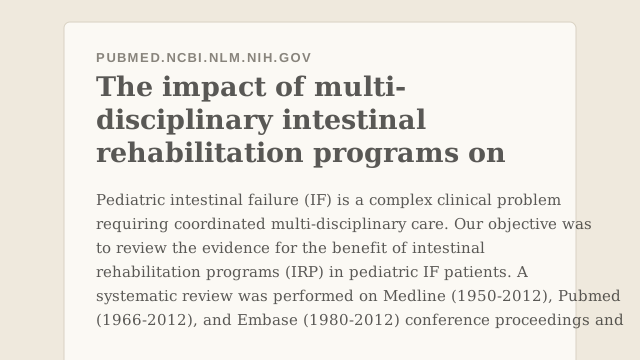
The impact of multi-disciplinary intestinal rehabilitation programs on the outcome of pediatric patients with intestinal failure: a systematic review and meta-analysis.
Paul Wales · Published Nov 2026
Article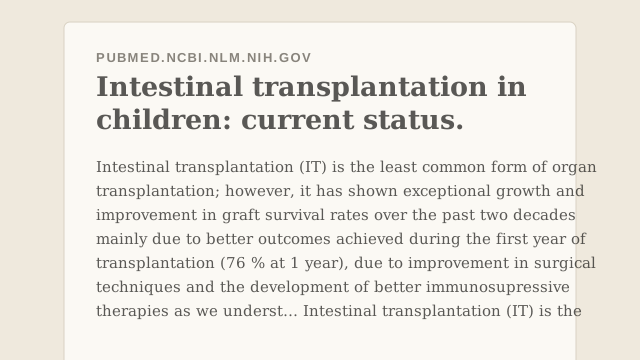
Intestinal transplantation in children: current status.
Paul Wales · Published Nov 2026