


From
Dr. Roshni Dasgupta
Interhospital variability in localization techniques for small pulmonary nodules in children: A pediatric surgical oncology research collaborative study
pubmed.ncbi.nlm.nih.gov shows its articles on its own site.
Read the article on pubmed.ncbi.nlm.nih.gov ↗Article · Feb 2022 · 1 min read
In brief
In brief
Multi-institutional study of 225 pediatric patients reveals wide institutional variation in techniques for localizing small lung nodules, with six different methods showing comparable success rates (92-100% localization, 94-100% resection) but significant differences in procedure times. Despite technical diversity, all approaches proved effective for guiding biopsy of deep or small pulmonary lesions in children.
Written by the GCMD Library team from the article.
Background: Pulmonary nodules that are deep within lung parenchyma and/or small in size can be challenging to localize for biopsy. This study describes current trends in performance of image-guided localization techniques for pulmonary nodules in pediatric patients. Methods: A retrospective review was performed on patients < 21 years of age undergoing localization of pulmonary nodules at 15 institutions. Localization and resection success, time in interventional radiology (IR), operating room (OR) and total anesthesia time, complications, and technical problems were compared between techniques. Results: 225 patients were included with an average of 1.3 lesions (range 1-5). Median nodule size and depth were 4 mm (range 0-30) and 5.4 mm (0-61), respectively. The most common localization techniques were: wire + methylene blue dye (MBD) (28%), MBD only (25%), wire only (14%), technetium-99 only (11%), coil + MBD (7%) and coil only (5%). Localization technique was associated with institution (p < 0.01); technique and institution were significantly associated with mean IR, OR, and anesthesia time (all p < 0.05). Comparing techniques, there was no difference in successful IR localization (range 92-100%, p = 0.75), successful resection (94-100%, p = 0.98), IR technical problems (p = 0.22), or operative complications (p = 0.16). Conclusions: Many IR localization techniques for small pulmonary nodules in children can be successful, but there is wide variability in application by instit
Educational content from recorded physician discussions — not medical advice. Talk to your (or your child's) care team about your situation.
Article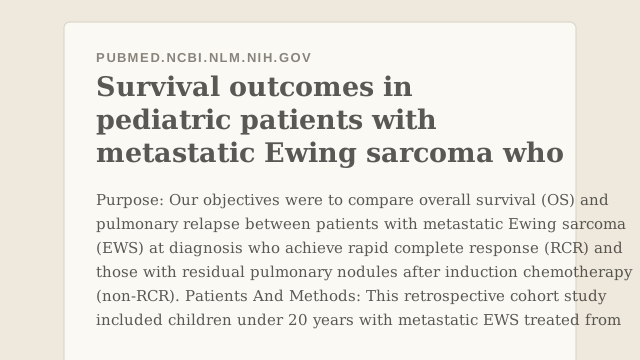
Survival outcomes in pediatric patients with metastatic Ewing sarcoma who achieve a rapid complete response of pulmonary metastases
Roshni Dasgupta · Published Apr 2024
Podcast
Thoracoscopic lung nodule resection techniques with wire localization and ICG imaging
Roshni Dasgupta · 10 min · Published Jul 2022
Podcast
Hybrid OR workflow for pediatric lung nodule localization and resection
Roshni Dasgupta · 17 min · Published Jun 2022
Video
Update Course Rewind: Thoracotomy vs VATS for Lung Metastases
Dr. Todd Ponsky · 9 min · Published Dec 2021
Article
Pneumonectomy for Pediatric Tumors-a Pediatric Surgical Oncology Research Collaborative Study
Roshni Dasgupta · Published Jan 2021
Article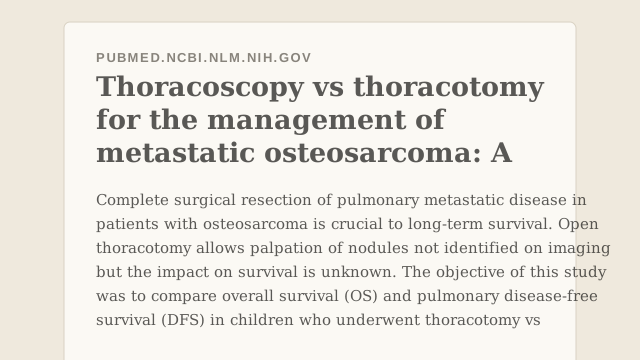
Thoracoscopy vs thoracotomy for the management of metastatic osteosarcoma: A Pediatric Surgical Oncology Research Collaborative Study
Roshni Dasgupta · Published Aug 2020
Article
Pediatric Surgical Oncology
Roshni Dasgupta · Published Oct 2026
Article
Contemporary Biology, Management, and Outcomes of Renal Medullary Carcinoma in Children and Adults: A Pediatric Surgical Oncology Research Collaborative Study
Roshni Dasgupta · Published Oct 2026
Article
Pediatric Cancer, An Issue of Surgical Oncology Clinics of North America, E-Book
Roshni Dasgupta · Published Oct 2026
Article
An Introduction to Pediatric Surgical Oncology
Roshni Dasgupta · Published Oct 2026
Article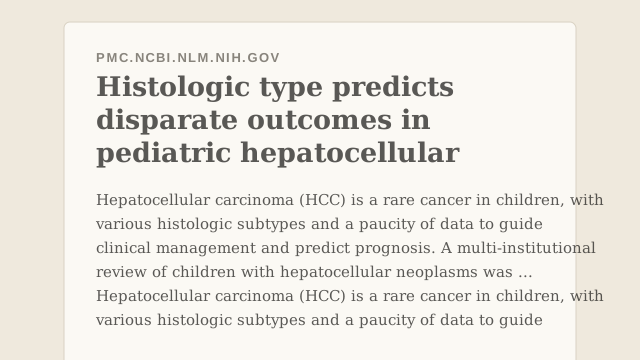
Histologic type predicts disparate outcomes in pediatric hepatocellular neoplasms: A Pediatric Surgical Oncology Research Collaborative study
Roshni Dasgupta · Published Oct 2026
Article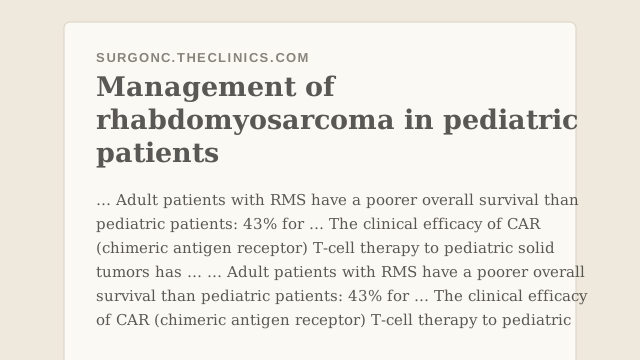
Management of rhabdomyosarcoma in pediatric patients
Roshni Dasgupta · Published Oct 2026