


From
Dr. Roshni Dasgupta
Impact of local control and surgical lymph node evaluation in localized paratesticular rhabdomyosarcoma: A report from the Children's Oncology Group Soft Tissue Sarcoma Committee
Part of
Rhabdomyosarcoma 8 items
onlinelibrary.wiley.com shows its articles on its own site.
Read the article on onlinelibrary.wiley.com ↗Article · Jul 2020 · 1 min read
In brief
In brief
This Children's Oncology Group study of 279 patients with localized paratesticular rhabdomyosarcoma demonstrates excellent 5-year event-free survival (92%) and reveals that imaging alone misses over half of nodal disease in patients older than 10 years. The analysis suggests optimal lymph node staging requires sampling 7-12 retroperitoneal nodes, though surgical approach did not significantly impact survival outcomes.
Written by the GCMD Library team from the article.
Abstract Paratesticular rhabdomyosarcoma (PT‐RMS) carries a favorable prognosis, but questions persist regarding optimal management. Our goal was to determine the importance of primary tumor resection and surgical assessment of retroperitoneal lymph nodes during staging in patients with PT‐RMS. We analyzed patients with localized PT‐RMS enrolled onto one of four Children's Oncology Group studies (D9602, ARST0331, D9803 or ARST0531). Surgical resection of the primary tumor prior to chemotherapy and radiotherapy was encouraged when possible with retroperitoneal lymph node dissection (RPLND) recommended for patients ≥10 years of age. Among 279 patients (median 8.1 years old), most tumors were resected with negative margins (78.5%) and most patients did not have radiographic enlargement of regional lymph nodes (90.3%). In patients older than 10 years, imaging alone will miss over 51.5% of nodal disease. Five‐year event‐free survival (EFS) was 92.0% (95% CI 88.4%‐95.6%). Sampling ≥7 to 12 retroperitoneal lymph nodes appeared optimal for detecting positive nodes; while there was a trend toward improved EFS among those undergoing template RPLND, this was not statistically significant ( P = .068). Age ( P = .28), N‐stage ( P = .39), T‐stage ( P = .11) and pathologic node involvement ( P = .53) were not associated with overall survival. However, older age and larger tumor size had an additive impact on EFS ( P = .027) though not overall survival ( P = .13). In conclusion, outcomes for
Educational content from recorded physician discussions — not medical advice. Talk to your (or your child's) care team about your situation.
Article
Management of rhabdomyosarcoma in pediatric patients
Roshni Dasgupta · Published Oct 2026
Video
Pediatric Sarcoma Surgical Margins: Rhabdomyosarcoma Treatment Guidelines w/ Dr. Roshni Dasgupta
25 s · Published Oct 2026
Video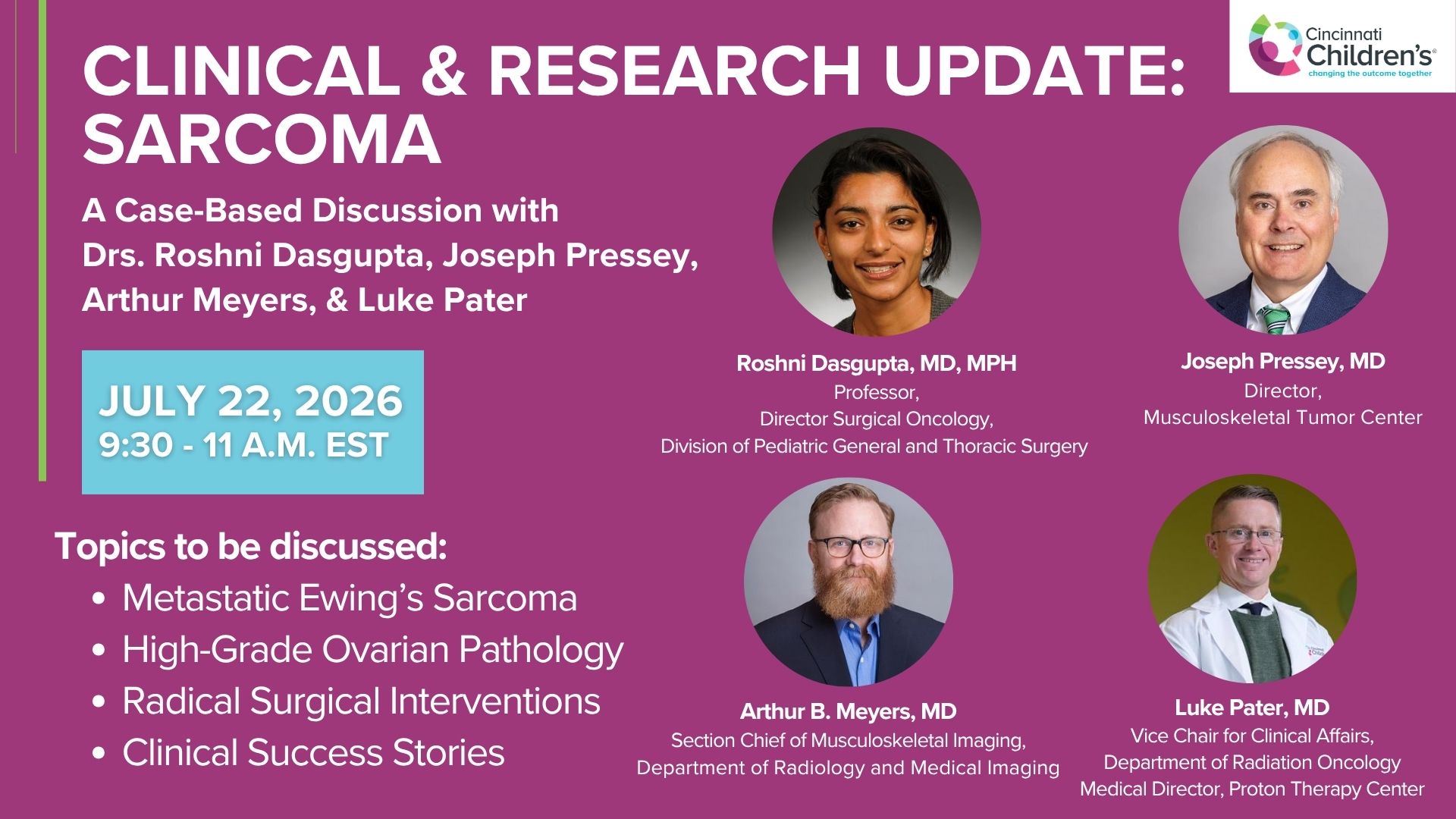
Clinical & Research Update: Sarcoma w/ Drs. Roshni Dasgupta, Joseph Pressey, Arthur Meyer, Luke Pater
66 min · Published Sep 2026
Article
Outcomes for patients with perineal and perianal rhabdomyosarcoma: A report from the Children's Oncology Group Soft Tissue Sarcoma Committee
Roshni Dasgupta · Published Sep 2024
Article
Critical elements of pediatric rhabdomyosarcoma surgery
Roshni Dasgupta · Published Nov 2023
Video
Technical approaches to rhabdomyosarcoma management: APSA Cancer Committee case series
Roshni Dasgupta · 17 min · Published Feb 2022
Article
Histologic type predicts disparate outcomes in pediatric hepatocellular neoplasms: A Pediatric Surgical Oncology Research Collaborative study
Roshni Dasgupta · Published Oct 2026
Article
Contemporary Biology, Management, and Outcomes of Renal Medullary Carcinoma in Children and Adults: A Pediatric Surgical Oncology Research Collaborative Study
Roshni Dasgupta · Published Oct 2026
Article
Pediatric Cancer, An Issue of Surgical Oncology Clinics of North America, E-Book
Roshni Dasgupta · Published Oct 2026
Article
An Introduction to Pediatric Surgical Oncology
Roshni Dasgupta · Published Oct 2026
Article
Pediatric Surgical Oncology
Roshni Dasgupta · Published Oct 2026
Article
Pediatric Oncology, An Issue of Surgical Oncology Clinics of North America
Roshni Dasgupta · Published Oct 2026