


From
Dr. Alberto Tozzi
[An LLM for a friend.]
pubmed.ncbi.nlm.nih.gov shows its articles on its own site.
Read the article on pubmed.ncbi.nlm.nih.gov ↗Article · Jan 2024 · 1 min read
In brief
In brief
This article examines the emerging role of large language models in healthcare, including automated transcription, diagnostic support, and enhanced physician-patient communication. The authors identify key adoption barriers—data privacy concerns, digital literacy gaps, and workflow integration challenges—and emphasize the need for clinician training and interdisciplinary research to transform AI into practical augmented intelligence tools.
Written by the GCMD Library team from the article.
The large language models (LLMs) represent a technology that has not yet seen widespread use. In addition to the automatic transcription of doctor-patient conversations, these tools will be able to support doctors in diagnosis and improve communication between doctors and patients. Their large-scale adoption is still limited due to concerns about sharing sensitive data, a lack of digital literacy, and the need to build new processes in clinical routines. To fully realize their potential, it is essential to train healthcare personnel on the functionalities of LLMs and to promote interdisciplinarity and scientific research, transforming artificial intelligence into augmented intelligence.
Educational content from recorded physician discussions — not medical advice. Talk to your (or your child's) care team about your situation.
Podcast
Le funzioni e gli usi dell'intelligenza artificiale per la salute
Alberto Tozzi · 14 min · Published Oct 2026
Podcast
Data to impact: connecting the future of European pediatrics with Alberto Tozzi
Alberto Tozzi · 20 min · Published Oct 2026
Article
Hepatitis B immune memory in children primed with hexavalent vaccines and given monovalent booster vaccines: an open-label, randomised, controlled, multicentre study.
Alberto Tozzi · Published Oct 2026
Article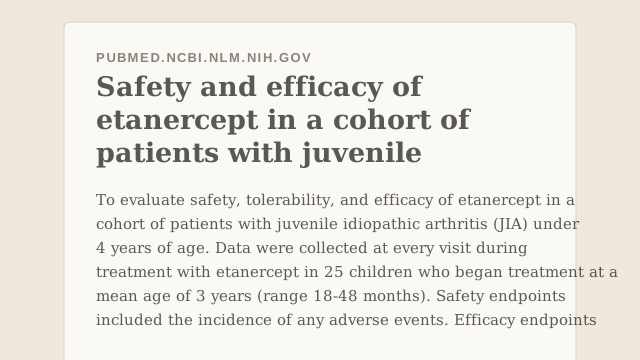
Safety and efficacy of etanercept in a cohort of patients with juvenile idiopathic arthritis under 4 years of age.
Alberto Tozzi · Published Oct 2026
Article
Towards learning healthcare systems in Italy: opportunities and challenges of AI at point-of-care.
Alberto Tozzi · Published Oct 2026
Article
[Obesity and cardiovascular risk in children].
Alberto Tozzi · Published Oct 2026